Showing posts with label transhumanism. Show all posts

Friday, November 15, 2013

"The Coming of the Ice" (1926) by G. Peyton Wertenbaker, with Notes and Commentary


"The Coming of the Ice"

© 1926

by

G. Peyton Wertenbaker


It is strange to be alone, and so cold. To be the last man on earth....

The snow drives silently about me, ceaselessly, drearily. And I am isolated in this tiny white, indistinguishable corner of a blurred world, surely the loneliest creature in the universe. How many thousands of years is it since I last knew the true companionship? For a long time I have been lonely, but there were people, creatures of flesh and blood. Now they are gone. Now I have not even the stars to keep me company, for they are all lost in an infinity of snow and twilight here below.

If only I could know how long it has been since first I was imprisoned upon the earth. It cannot matter now. And yet some vague dissatisfaction, some faint instinct, asks over and over in my throbbing ears: What year? What year?


It was in the year 1930 that the great thing began in my life. There was then a very great man who performed operations on his fellows to compose their vitals—we called such men surgeons. John Granden wore the title "Sir" before his name, in indication of nobility by birth according to the prevailing standards in England. But surgery was only a hobby of Sir John's, if I must be precise, for, while he had achieved an enormous reputation as a surgeon, he always felt that his real work lay in the experimental end of his profession. He was, in a way, a dreamer, but a dreamer who could make his dreams come true.

I was a very close friend of Sir John's. In fact, we shared the same apartments in London. I have never forgotten that day when he first mentioned to me his momentous discovery. I had just come in from a long sleigh-ride in the country with Alice, and I was seated drowsily in the window-seat, writing idly in my mind a description of the wind and the snow and the grey twilight of the evening. It is strange, is it not, that my tale should begin and end with the snow and the twilight.

Sir John opened suddenly a door at one end of the room and came hurrying across to another door. He looked at me, grinning rather like a triumphant maniac.

"It's coming!" he cried, without pausing, "I've almost got it!" I smiled at him: he looked very ludicrous at that moment.

"What have you got?" I asked.

"Good Lord, man, the Secret—the Secret!" And then he was gone again, the door closing upon his victorious cry, "The Secret!"

I was, of course, amused. But I was also very much interested. I knew Sir John well enough to realize that, however amazing his appearance might be, there would be nothing absurd about his "Secret"—whatever it was. But it was useless to speculate. I could only hope for enlightenment at dinner. So I immersed myself in one of the surgeon's volumes from his fine Library of Imagination, and waited.

I think the book was one of Mr. H. G. Wells', probably "The Sleeper Awakes," or some other of his brilliant fantasies and predictions, for I was in a mood conducive to belief in almost anything when, later, we sat down together across the table. I only wish I could give some idea of the atmosphere that permeated our apartments, the reality it lent to whatever was vast and amazing and strange. You could then, whoever you are, understand a little the ease with which I accepted Sir John's new discovery.

He began to explain it to me at once, as though he could keep it to himself no longer.

"Did you think I had gone mad, Dennell?" he asked. "I quite wonder that I haven't. Why, I have been studying for many years—for most of my life—on this problem. And, suddenly, I have solved it! Or, rather, I am afraid I have solved another one much greater."

"Tell me about it, but for God's sake don't be technical."

"Right," he said. Then he paused. "Dennell, it's magnificent! It will change everything that is in the world." His eyes held mine suddenly with the fatality of a hypnotist's. "Dennell, it is the Secret of Eternal Life," he said.

"Good Lord, Sir John!" I cried, half inclined to laugh.

"I mean it," he said. "You know I have spent most of my life studying the processes of birth, trying to find out precisely what went on in the whole history of conception."

"You have found out?"

"No, that is just what amuses me. I have discovered something else without knowing yet what causes either process.

"I don't want to be technical, and I know very little of what actually takes place myself. But I can try to give you some idea of it."


It is thousands, perhaps millions of years since Sir John explained to me. What little I understood at the time I may have forgotten, yet I try to reproduce what I can of his theory.

"In my study of the processes of birth," he began, "I discovered the rudiments of an action which takes place in the bodies of both men and women. There are certain properties in the foods we eat that remain in the body for the reproduction of life, two distinct Essences, so to speak, of which one is retained by the woman, another by the man. It is the union of these two properties that, of course, creates the child (1).

"Now, I made a slight mistake one day in experimenting with a guinea-pig, and I re-arranged certain organs which I need not describe so that I thought I had completely messed up the poor creature's abdomen. It lived, however, and I laid it aside. It was some years later that I happened to notice it again. It had not given birth to any young, but I was amazed to note that it had apparently grown no older: it seemed precisely in the same state of growth in which I had left it.

"From that I built up. I re-examined the guinea-pig, and observed it carefully. I need not detail my studies. But in the end I found that my 'mistake' had in reality been a momentous discovery. I found that I had only to close certain organs, to re-arrange certain ducts, and to open certain dormant organs, and, mirabile dictu, the whole process of reproduction was changed.

"You have heard, of course, that our bodies are continually changing, hour by hour, minute by minute, so that every few years we have been literally reborn. Some such principle as this seems to operate in reproduction, except that, instead of the old body being replaced by the new, and in its form, approximately, the new body is created apart from it. It is the creation of children that causes us to die, it would seem, because if this activity is, so to speak, dammed up or turned aside into new channels, the reproduction operates on the old body, renewing it continually (2). It is very obscure and very absurd, is it not? But the most absurd part of it is that it is true. Whatever the true explanation may be, the fact remains that the operation can be done, that it actually prolongs life indefinitely, and that I alone know the secret."

Sir John told me a very great deal more, but, after all, I think it amounted to little more than this. It would be impossible for me to express the great hold his discovery took upon my mind the moment he recounted it. From the very first, under the spell of his personality, I believed, and I knew he was speaking the truth. And it opened up before me new vistas. I began to see myself become suddenly eternal, never again to know the fear of death. I could see myself storing up, century after century, an amplitude of wisdom and experience that would make me truly a god.

"Sir John!" I cried, long before he was finished. "You must perform that operation on me!"

"But, Dennell, you are too hasty. You must not put yourself so rashly into my hands."

"You have perfected the operation, haven't you?"

"That is true," he said.

"You must try it out on somebody, must you not?"

"Yes, of course. And yet—somehow, Dennell, I am afraid. I cannot help feeling that man is not yet prepared for such a vast thing. There are sacrifices. One must give up love and all sensual pleasure. This operation not only takes away the mere fact of reproduction, but it deprives one of all the things that go with sex, all love, all sense of beauty, all feeling for poetry and the arts. It leaves only the few emotions, selfish emotions, that are necessary to self-preservation. Do you not see? One becomes an intellect, nothing more—a cold apotheosis of reason. And I, for one, cannot face such a thing calmly." (3)

"But, Sir John, like many fears, it is largely horrible in the foresight. After you have changed your nature you cannot regret it. What you are would be as horrible an idea to you afterwards as the thought of what you will be seems now."

"True, true. I know it. But it is hard to face, nevertheless."

"I am not afraid to face it."

"You do not understand it, Dennell, I am afraid. And I wonder whether you or I or any of us on this earth are ready for such a step. After all, to make a race deathless, one should be sure it is a perfect race." (4)

"Sir John," I said, "it is not you who have to face this, nor any one else in the world till you are ready. But I am firmly resolved, and I demand it of you as my friend."

Well, we argued much further, but in the end I won. Sir John promised to perform the operation three days later.

... But do you perceive now what I had forgotten during all that discussion, the one thing I had thought I could never forget so long as I lived, not even for an instant? It was my love for Alice—I had forgotten that! (5)


I cannot write here all the infinity of emotions I experienced later, when, with Alice in my arms, it suddenly came upon me what I had done. Ages ago—I have forgotten how to feel. I could name now a thousand feelings I used to have, but I can no longer even understand them. For only the heart can understand the heart, and the intellect only the intellect.

With Alice in my arms, I told the whole story. It was she who, with her quick instinct, grasped what I had never noticed (6).

"But Carl!" she cried, "Don't you see?—It will mean that we can never be married!" And, for the first time, I understood. If only I could re-capture some conception of that love! I have always known, since the last shred of comprehension slipped from me, that I lost something very wonderful when I lost love. But what does it matter? I lost Alice too, and I could not have known love again without her.

We were very sad and very tragic that night. For hours and hours we argued the question over. But I felt somewhat that I was inextricably caught in my fate, that I could not retreat now from my resolve. I was perhaps, very school-boyish, but I felt that it would be cowardice to back out now. But it was Alice again who perceived a final aspect of the matter.

"Carl," she said to me, her lips very close to mine, "it need not come between our love. After all, ours would be a poor sort of love if it were not more of the mind than of the flesh. We shall remain lovers, but we shall forget mere carnal desire. I shall submit to that operation too!" (7)

And I could not shake her from her resolve. I would speak of danger that I could not let her face. But, after the fashion of women, she disarmed me with the accusation that I did not love her, that I did not want her love, that I was trying to escape from love. What answer had I for that, but that I loved her and would do anything in the world not to lose her?

I have wondered sometimes since whether we might have known the love of the mind. Is love something entirely of the flesh, something created by an ironic God merely to propagate His race? Or can there be love without emotion, love without passion—love between two cold intellects? (8) I do not know. I did not ask then. I accepted anything that would make our way more easy.

There is no need to draw out the tale. Already my hand wavers, and my time grows short. Soon there will be no more of me, no more of my tale—no more of Mankind. There will be only the snow, and the ice, and the cold ...


Three days later I entered John's Hospital with Alice on my arm. All my affairs—and they were few 
enough—were in order. I had insisted that Alice wait until I had come safely through the operation, before she submitted to it. I had been carefully starved for two days, and I was lost in an unreal world of white walls and white clothes and white lights, drunk with my dreams of the future. When I was wheeled into the operating room on the long, hard table, for a moment it shone with brilliant distinctness, a neat, methodical white chamber, tall and more or less circular. Then I was beneath the glare of soft white lights, and the room faded into a misty vagueness from which little steel rays flashed and quivered from silvery cold instruments. For a moment our hands, Sir John's and mine, gripped, and we were saying good-bye—for a little while—in the way men say these things. Then I felt the warm touch of Alice's lips upon mine, and I felt sudden painful things I cannot describe, that I could not have described then. For a moment I felt that I must rise and cry out that I could not do it. But the feeling passed, and I was passive.

Something was pressed about my mouth and nose, something with an ethereal smell. Staring eyes swam about me from behind their white masks. I struggled instinctively, but in vain—I was held securely. Infinitesimal points of light began to wave back and forth on a pitch-black background; a great hollow buzzing echoed in my head. My head seemed suddenly to have become all throat, a great, cavernous, empty throat in which sounds and lights were mingled together, in a swift rhythm, approaching, receding eternally. Then, I think, there were dreams. But I have forgotten them....

I began to emerge from the effect of the ether. Everything was dim, but I could perceive Alice beside me, and Sir John.

"Bravely done!" Sir John was saying, and Alice, too, was saying something, but I cannot remember what. For a long while we talked, I speaking the nonsense of those who are coming out from under ether, they teasing me a little solemnly. But after a little while I became aware of the fact that they were about to leave. Suddenly, God knows why, I knew that they must not leave. Something cried in the back of my head that they must stay—one cannot explain these things, except by after events. I began to press them to remain, but they smiled and said they must get their dinner. I commanded them not to go; but they spoke kindly and said they would be back before long. I think I even wept a little, like a child, but Sir John said something to the nurse, who began to reason with me firmly, and then they were gone, and somehow I was asleep....


When I awoke again, my head was fairly clear, but there was an abominable reek of ether all about me. The moment I opened my eyes, I felt that something had happened. I asked for Sir John and for Alice. I saw a swift, curious look that I could not interpret come over the face of the nurse, then she was calm again, her countenance impassive. She reassured me in quick meaningless phrases, and told me to sleep. But I could not sleep: I was absolutely sure that something had happened to them, to my friend and to the woman I loved. Yet all my insistence profited me nothing, for the nurses were a silent lot. Finally, I think, they must have given me a sleeping potion of some sort, for I fell asleep again.

For two endless, chaotic days, I saw nothing of either of them, Alice or Sir John. I became more and more agitated, the nurse more and more taciturn. She would only say that they had gone away for a day or two.

And then, on the third day, I found out. They thought I was asleep. The night nurse had just come in to relieve the other.

"Has he been asking about them again?" she asked.

"Yes, poor fellow. I have hardly managed to keep him quiet."

"We will have to keep it from him until he is recovered fully." There was a long pause, and I could hardly control my labored breathing.

"How sudden it was!" one of them said. "To be killed like that—" I heard no more, for I leapt suddenly up in bed, crying out.

"Quick! For God's sake, tell me what has happened!" I jumped to the floor and seized one of them by the collar. She was horrified. I shook her with a superhuman strength.

"Tell me!" I shouted, "Tell me—Or I'll—!" She told me—what else could she do.

"They were killed in an accident," she gasped, "in a taxi—a collision—the Strand—!" (9) And at that moment a crowd of nurses and attendants arrived, called by the other frantic woman, and they put me to bed again.

I have no memory of the next few days. I was in delirium, and I was never told what I said during my ravings. Nor can I express the feelings I was saturated with when at last I regained my mind again. Between my old emotions and any attempt to put them into words, or even to remember them, lies always that insurmountable wall of my Change. I cannot understand what I must have felt, I cannot express it.
I only know that for weeks I was sunk in a misery beyond any misery I had ever imagined before. The only two friends I had on earth were gone to me. I was left alone. And, for the first time, I began to see before me all these endless years that would be the same, dull, lonely.

Yet I recovered. I could feel each day the growth of a strange new vigor in my limbs, a vast force that was something tangibly expressive to eternal life. Slowly my anguish began to die. After a week more, I began to understand how my emotions were leaving me, how love and beauty and everything of which poetry was made—how all this was going. I could not bear the thought at first. I would look at the golden sunlight and the blue shadow of the wind, and I would say,
"
God! How beautiful!" And the words would echo meaninglessly in my ears. Or I would remember Alice's face, that face I had once loved so inextinguishably, and I would weep and clutch my forehead, and clench my fists, crying,
"
O God, how can I live without her!" Yet there would be a little strange fancy in my head at the same moment, saying,
"
Who is this Alice? You know no such person." And truly I would wonder whether she had ever existed (10).

So, slowly, the old emotions were shed away from me, and I began to joy in a corresponding growth of my mental perceptions. I began to toy idly with mathematical formulae I had forgotten years ago, in the same fashion that a poet toys with a word and its shades of meaning. I would look at everything with new, seeing eyes, new perception, and I would understand things I had never understood before, because formerly my emotions had always occupied me more than my thoughts.

And so the weeks went by, until, one day, I was well.


What, after all, is the use of this chronicle? Surely there will never be men to read it. I have heard them say that the snow will never go. I will be buried, it will be buried with me; and it will be the end of us both. Yet, somehow, it eases my weary soul a little to write....

Need I say that I lived, thereafter, many thousands of thousands of years, until this day? I cannot detail that life. It is a long round of new, fantastic impressions, coming dream-like, one after another, melting into each other. In looking back, as in looking back upon dreams, I seem to recall only a few isolated periods clearly; and it seems that my imagination must have filled in the swift movement between episodes. I think now, of necessity, in terms of centuries and millenniums, rather than days and months.... The snow blows terribly about my little fire, and I know it will soon gather courage to quench us both ...


Years passed, at first with a sort of clear wonder. I watched things that took place everywhere in the world. I studied. The other students were much amazed to see me, a man of thirty odd, coming back to college.

"But Judas, Dennell, you've already got your Ph.D! What more do you want?" So they would all ask me. And I would reply;

"I want an M.D. and an F.R.C.S." I didn't tell them that I wanted degrees in Law, too, and in Biology and Chemistry, in Architecture and Engineering, in Psychology and Philosophy. Even so, I believe they thought me mad. But poor fools! I would think. They can hardly realize that I have all of eternity before me to study.

I went to school for many decades. I would pass from University to University, leisurely gathering all the fruits of every subject I took up, revelling in study as no student revelled ever before. There was no need of hurry in my life, no fear of death too soon. There was a magnificence of vigor in my body, and a magnificence of vision and clarity in my brain. I felt myself a super-man. I had only to go on storing up wisdom until the day should come when all knowledge of the world was mine, and then I could command the world. I had no need for hurry. O vast life! How I gloried in my eternity! And how little good it has ever done me, by the irony of God.

For several centuries, changing my name and passing from place to place, I continued my studies. I had no consciousness of monotony, for, to the intellect, monotony cannot exist: it was one of those emotions I had left behind. One day, however, in the year 2132, a great discovery was made by a man called Zarentzov. It had to do with the curvature of space, quite changing the conceptions that we had all followed since Einstein. I had long ago mastered the last detail of Einstein's theory, as had, in time, the rest of the world. I threw myself immediately into the study of this new, epoch-making conception.

To my amazement, it all seemed to me curiously dim and elusive. I could not quite grasp what Zarentzov was trying to formulate.

"Why," I cried, "the thing is a monstrous fraud!" I went to the professor of Physics in the University I then attended, and I told him it was a fraud, a huge book of mere nonsense. He looked at me rather pityingly.

"I am afraid, Modevski," he said, addressing me by the name I was at the time using, "I am afraid you do not understand it, that is all. When your mind has broadened, you will. You should apply yourself more carefully to your Physics." But that angered me, for I had mastered my Physics before he was ever born. I challenged him to explain the theory. And he did! He put it, obviously, in the clearest language he could. Yet I understood nothing. I stared at him dumbly, until he shook his head impatiently, saying that it was useless, that if I could not grasp it I would simply have to keep on studying. I was stunned. I wandered away in a daze.

For do you see what happened? During all those years I had studied ceaselessly, and my mind had been clear and quick as the day I first had left the hospital. But all that time I had been able only to remain what I was—an extraordinarily intelligent man of the twentieth century. And the rest of the race had been progressing! It had been swiftly gathering knowledge and power and ability all that time, faster and faster, while I had been only remaining still. And now here was Zarentzov and the teachers of the Universities, and, probably, a hundred intelligent men, who had all outstripped me! I was being left behind (11).

And that is what happened. I need not dilate further upon it. By the end of that century I had been left behind by all the students of the world, and I never did understand Zarentzov. Other men came with other theories, and these theories were accepted by the world. But I could not understand them. My intellectual life was at an end. I had nothing more to understand. I knew everything I was capable of knowing, and, thenceforth, I could only play wearily with the old ideas (12).


Many things happened in the world. A time came when the East and West, two mighty unified hemispheres, rose up in arms: the civil war of a planet. I recall only chaotic visions of fire and thunder and hell. It was all incomprehensible to me: like a bizarre dream, things happened, people rushed about, but I never knew what they were doing. I lurked during all that time in a tiny shuddering hole under the city of Yokohama, and by a miracle I survived. And the East won. But it seems to have mattered little who did win, for all the world had become, in all except its few remaining prejudices, a single race, and nothing was changed when it was all rebuilt again, under a single government (13).

I saw the first of the strange creatures who appeared among us in the year 6371, men who were later known to be from the planet Venus (14). But they were repulsed, for they were savages compared with the Earthmen, although they were about equal to the people of my own century, 1900. Those of them who did not perish of the cold after the intense warmth of their world, and those who were not killed by our hands, those few returned silently home again. And I have always regretted that I had not the courage to go with them.

I watched a time when the world reached perfection in mechanics, when men could accomplish anything with a touch of the finger. Strange men, these creatures of the hundredth century, men with huge brains and tiny shriveled bodies, atrophied limbs, and slow, ponderous movements on their little conveyances (15). It was I, with my ancient compunctions, who shuddered when at last they put to death all the perverts, the criminals, and the insane, ridding the world of the scum for which they had no more need. It was then that I was forced to produce my tattered old papers, proving my identity and my story. They knew it was true, in some strange fashion of theirs, and, thereafter, I was kept on exhibition as an archaic survival (16).

I saw the world made immortal through the new invention of a man called Kathol, who used somewhat the same method "legend" decreed had been used upon me (17). I observed the end of speech, of all perceptions except one, when men learned to communicate directly by thought, and to receive directly into the brain all the myriad vibrations of the universe (18).

All these things I saw, and more, until that time when there was no more discovery, but a Perfect World in which there was no need for anything but memory (19). Men ceased to count time at last. Several hundred years after the 154th Dynasty from the Last War, or, as we would have counted in my time, about 200,000 A.D., official records of time were no longer kept carefully. They fell into disuse. Men began to forget years, to forget time at all. Of what significance was time when one was immortal? (20)


After long, long uncounted centuries, a time came when the days grew noticeably colder. Slowly the winters became longer, and the summers diminished to but a month or two. Fierce storms raged endlessly in winter, and in summer sometimes there was severe frost, sometimes there was only frost. In the high places and in the north and the sub-equatorial south, the snow came and would not go.

Men died by the thousands in the higher latitudes. New York became, after awhile, the furthest habitable city north, an arctic city, where warmth seldom penetrated. And great fields of ice began to make their way southward, grinding before them the brittle remains of civilizations, covering over relentlessly all of man's proud work.

Snow appeared in Florida and Italy one summer. In the end, snow was there always. Men left New York, Chicago, Paris, Yokohama, and everywhere they traveled by the millions southward, perishing as they went, pursued by the snow and the cold, and that inevitable field of ice. They were feeble creatures when the Cold first came upon them, but I speak in terms of thousands of years; and they turned every weapon of science to the recovery of their physical power, for they foresaw that the only chance for survival lay in a hard, strong body. As for me, at last I had found a use for my few powers, for my physique was the finest in that world. It was but little comfort, however, for we were all united in our awful fear of that Cold and that grinding field of Ice. All the great cities were deserted. We would catch silent, fearful glimpses of them as we sped on in our machines over the snow—great hungry, haggard skeletons of cities, shrouded in banks of snow, snow that the wind rustled through desolate streets where the cream of human life once had passed in calm security. Yet still the Ice pursued. For men had forgotten about that Last Ice Age when they ceased to reckon time, when they lost sight of the future and steeped themselves in memories. They had not remembered that a time must come when Ice would lie white and smooth over all the earth, when the sun would shine bleakly between unending intervals of dim, twilight snow and sleet (21).

Slowly the Ice pursued us down the earth, until all the feeble remains of civilization were gathered in Egypt and India and South America. The deserts flowered again, but the frost would come always to bite the tiny crops. For still the Ice came. All the world now, but for a narrow strip about the equator, was one great silent desolate vista of stark ice-plains, ice that brooded above the hidden ruins of cities that had endured for hundreds of thousands of years. It was terrible to imagine the awful solitude and the endless twilight that lay on these places, and the grim snow, sailing in silence over all.... (22)
 
It surrounded us on all sides, until life remained only in a few scattered clearings all about that equator of the globe, with an eternal fire going to hold away the hungry Ice. Perpetual winter reigned now; and we were becoming terror-stricken beasts that preyed on each other for a life already doomed. Ah, but I, I the archaic survival, I had my revenge then, with my great physique and strong jaws—God! Let me think of something else. Those men who lived upon each other—it was horrible. And I was one.


So inevitably the Ice closed in.... One day the men of our tiny clearing were but a score. We huddled about our dying fire of bones and stray logs. We said nothing. We just sat, in deep, wordless, thoughtless silence. We were the last outpost of Mankind.

I think suddenly something very noble must have transformed these creatures to a semblance of what they had been of old. I saw, in their eyes, the question they sent from one to another, and in every eye I saw that the answer was, Yes. With one accord they rose before my eyes and, ignoring me as a baser creature, they stripped away their load of tattered rags and, one by one, they stalked with their tiny shrivelled limbs into the shivering gale of swirling, gusting snow, and disappeared. And I was alone.... (23)

So am I alone now. I have written this last fantastic history of myself and of Mankind upon a substance that will, I know, outlast even the snow and the Ice—as it has outlasted Mankind that made it. It is the only thing with which I have never parted. For is it not irony that I should be the historian of this race—I, a savage, an "archaic survival?" Why do I write? God knows, but some instinct prompts me, although there will never be men to read (24).

I have been sitting here, waiting, and I have thought often of Sir John and Alice, whom I loved. Can it be that I am feeling again, after all these ages, some tiny portion of that emotion, that great passion I once knew? I see her face before me, the face I have lost from my thoughts for eons, and something is in it that stirs my blood again. Her eyes are half-closed and deep, her lips are parted as though I could crush them with an infinity of wonder and discovery. O God! It is love again, love that I thought was lost! They have often smiled upon me when I spoke of God, and muttered about my foolish, primitive superstitions. But they are gone, and I am left who believe in God, and surely there is purpose in it.

I am cold, I have written. Ah, I am frozen. My breath freezes as it mingles with the air, and I can hardly move my numbed fingers. The Ice is closing over me, and I cannot break it any longer. The storm cries weirdly all about me in the twilight, and I know this is the end. The end of the world. And I—I, the last man....

The last man....

... I am cold—cold....

But is it you, Alice? Is it you?


END.


=====
NOTES
=====

(1) - There are certain properties in the foods we eat that remain in the body for the reproduction of life, two distinct Essences, so to speak, of which one is retained by the woman, another by the man. It is the union of these two properties that, of course, creates the child.

The importance of nucleic acid, and specifically the structure of DNA, would not be discovered for another generation.  The theory being expressed here is a biochemical version of Henri Bergson's elan vital, from Creative Evolution (1907).  It is of course wrong in detail, though it does generally anticipate the roles of DNA and RNA in the cell.

(2) - "... It is the creation of children that causes us to die, it would seem, because if this activity is, so to speak, dammed up or turned aside into new channels, the reproduction operates on the old body, renewing it continually ..."

This is a restatement of a very old theory, dating back at least a couple of thousand millennia, to the effect that the vital essences are drained off by sexuality in general (and reproduction in particular), and that therefore sexual self-denial would preserve life indefinitely.  It is quite true that frequent childbirth under pre-industrial conditions is likely to shorten a woman's life, and the energetic pursuit of sex for reasons of danger and disease to shorten a man's.  However, the existence disproof of this theory is that the celibate are not, in fact, immortal -- nor are they exceptionally long-lived save by the operations of the aforementioned factors.

(3) - The idea that stopping the sex drive would also stop all other aesthetic, creative and indeed positive emotional impulses is very much a product of Freudian psychological theory, and is almost certainly untrue.  Not ony isn't sex that central to even human psychology, but our affectionate emotions almost certainly derive from primitive mammalian ancestors, and specifically from maternal love and the desire to huddle for mutual warmth and protection.  In many mammals, affection and sex are entirely divorced, and asexually-oriented humans are certainly capable of appreciating art or loving their friends and family:  they lack sex drive, rather than lacking all positive emotions.

(4) - "... And I wonder whether you or I or any of us on this earth are ready for such a step. After all, to make a race deathless, one should be sure it is a perfect race."

This of course assumes that a "deathless" race could not change, or would never have the desire to change arising from purely rational motives.  Both assumptions strike me as dubious, though they well might be true as regards John Granden's specific procedure.

(5) - Mmm, so you've just had it explained to you that Granden's process will not only destroy your potency and your sex drive, but also all aesthetic and affectionate emotions, and it doesn't occur to you that going through this procedure might mess up your marriage plans?  Ah, those stiff-upper-life British types with their utter lack of common sense ...!

(6) - ... And Alice instantly perceives the obvious point which Dennell has missed. 

(7) - Alice loves Dennell perhaps more than he deserves.

(8) - Here we see the limitations of any philosophy of positive affect in the time before the development of game theory.  First pioneered by John von Neumann and outlined first in  On the Theory of Parlor Games (1928) and then in greater scope in a paper, Theory of Games and Economic Behavior (1944) co-written with Oskar Morgenstern, game theory gained wide acceptance in the 1950's.  Its significance is that it shows why, in purely and coldly-logical terms, benevolence and cooperation are wise strategies.  A lot of early science fiction assumes that utterly-rational beings would also be amoral and might be utterly-uncooperative:  it is thanks to game theory that we now know that this is improbable. 

(9) - Truly a diablos ex machina, and one which obviously acts to reduce Dennell's emotional connections with the rest of the human race.

(10) - Dennell is incapable of understanding his old emotionally-tinged memories of Alice, or indeed of anything else which produced postive emotional affect in him.  This is one of the reasons why I wouldn't volunteer for this process:  immortality without emotional pleasure would be personally-meaningless.

(11) - This seems to assume that people are eternally-limited by the assumptions they first learned, which actually makes little sense if one has essentially unlimited wealth (a coldly-rational immortal could easily save enough money to invest in such a way as to become wealthy in half a century) and can continuously study.  A more plausible explanation is that the very regenerative powers of the Granden Process are limiting the ability of Dennell's mind to form new neural connections and specifically to prune old ones.  This would pose especial problems for an immortal, and note that by this point Dennell is something like 200 years old.

(12) - It's a bit surprising, though that in over 200 years of medical progress, nobody has figured out how to duplicate, improve or reverse the Granden Process, even though Dennell knows the Process is possible and could presumably tell other scientists.  This is of course a necessary assumption for the narrative.

(13) - This is something of a Take That to the Yellow Peril theories then very common, and popular in Interwar Era science-fiction.  Wertenbaker (correctly, in my opinion) points out that after centuries of globalization, the very racial differences which frightened the theorists would have long since vanished as the races of Man merged into one.  Even the cultures of East and West have by this time become one, to the point that the change of management is meaningless from Dennell's admittedly-cold point of view.

(14) - Much Interwar Era science-fiction deeply overestimated the difficulty of inter-planetary travel.  It is of course possible that a civilization thousands of years in advance of our time would either be unable or uninterested in the situation on the closest major terrestrial planet to their own, and of course 4500 years is enough time for two whole cycles of civilizations rising and falling.

(15) - The notion of men of the future as giant-brained creatures manipulating the physical world entirely by machinery dates back to the early 20th century, and can also be seen in Stapledon's Last and First Men (1930) and. Hamilton's "The Man Who Evolved" (1931) (which I once reviewed here).  The idea derives from the observation of human evolutionary changes from the other great apes, and is decades older even than "The Coming of the Ice" (which, however, pre-dates my other two examples of its application). 

(16) - The irony here is that Dennell, who has been rendered emotionally-flat by the Granden Process, is emotionally-horrified by the cruelty of the 7th Millennial culture -- because he remembers a kinder and more sentimental civilization.

(17) - At this point humanity has well and truly passed by Dennell, because Kathol has reinvented the Granden Process.  Dennell meant to be a god among men, but is now simply an archaic survival.

(18) - The development of universal human telepathy may have been the last flowering of the culture of the super-intelligent cyborgs, because if the Kathol Process works exactly like the Granden Process, it would logically freeze their further cultural development, probably in no more than a millennium.

(19) - From Dennell's point of view.  Since he has only a very limited understanding of the culture of the telepathic super-intelligent cyborgs, who are far his intellectual superiors, this may be the apparent "perfection" of the human world as viewed by a domestic cat.

(20) - It seems obvious to me that the Perfect World has become highly-decadent -- as the events of the next section strongly imply.

(21) - Notice that the supposed "Perfect World" of ultimate technological development is unable to engage in large-scale climatological engineering?  Or colonize other planets, or even handle a terrestrial migration competently.  And they've forgotten about the last Ice Age, despite the fact that they could simply ask Dennell about it.  As I said, highly-decadent.

(22) - This is more than a mere Ice Age.  It is a Snowball Earth event.  It is quite likely that the actions of the men of the Perfect World, as they lost their records and their science became myth, severely damaged the planetary atmosphere in such a way as to prevent the climate from stablizing at merely Pleistocene levels of temperature.

The last such event was the Marinoan Glaciation, which lasted from 650-635 MYA.  Neither this event, nor its timing, nor the very possibility of Snowball Earth events, were known in the early 20th century when this story was written.

(23) - I would call it a surrender to an inevitability which became inevitable first largely through the arrogant ignorance of the men of the Perfect World, and then through their repeated underestimation of the threat until matters had gone too far for reversal.  This is hardly "nobility," it's more like a tantrum at the unfriendliness of the Universe to the intellectually self-blinded.  But then, Dennell is cold in more than one sense of the word, as indeed were the super-intelligent cyborgs.

(24) - What, no one ever founded successful inter-planetary or inter-stellar colonies in hundreds of millennia?  And remember, the Kathol Process was not discovered until around 200,000 AD, so Mankind had lots of time before they froze their intellectual development.  Though of course it's possible that the other descendants of the men of today are far more alien to Dennell than were the super-intelligent cyborgs.  And of course Dennell has no way to actually contact them at this point:  he's freezing to death somewhere near Earth's Equator.


===========
COMMENTS
=========== 

This is the story of a quest for Transcendence gone horribly right.  John Granden sought immortality because it is an obvious medical goal.  Dennell wanted to become immortal, despite the drawbacks of the process, because he was fascinated by the future and wanted to become a god amongst men.  And he indeed got to live for hundreds of thousands of years, eventually becoming the last man on Earth.

The price of this was literally his humanity.  He lost the ability to have sex, to love, even to experience much in the way of any emotional affect.  His mind -- merely-human despite his flattened emotions -- was unable to adapt much after a mere two centuries of life.  He spent thousands of years hiding his true nature as the world around him grew increasingly alien, and finally became a sort of museum-piece, valued by the posthumans around him largely for his rarity.  And he witnesses the (protracted and depressing) end of the human race on Earth.

This is clearly meant as a cautionary tale.  Had Dennell not undergone the Granden Process, he would have had a normal and perhaps happy life in the 20th century.  Becoming immortal destroyed most of his ability to experience happiness and eventually resulted in him living for hundreds of millennia in  a world more alien to him than the 20th century would have been to an earlier human species.  And there is a strong hint that when humanity as a whole became immortal telepathic super-intelligent cyborgs, they lost their drive, leading to their ultimate extirpation on Earth (and possibly extinction in the Universe).

The nature of Dennell's life strikes me as nightmarish.  He doesn't describe it that way, but then he has trouble experiencing any emotions at all.  Consider this:  he enjoys something like 200 years of actually being able to understand the discoveries of the future.  This is followed by more than 4,000 years of finding himself in an increasingly-alien world which he cannot really understand no matter how hard he tries, surviving mainly because he got very good at survival over that first two centuries.  Then, when he has to reveal his true identity and nature (because Earthly culture has evolved into something so cruel that it would kill him merely for being different) he spends well over 200,000 years as a curiosity, living in a world that is now almost completely incomprehensible to him.  He doesn't even seem to fully-grasp just how decadent the Perfect World has become until it is wiped out by a Snowball Earth event, probably because he only has the vaguest possible notion of how any of it works.

From a modern point of view, it is interesting and a bit puzzling how Earthly humanity manages to reach such a dead-end of development.  By 6371 AD, Earth humans are far more advanced than are the Venusians, who are able (with an essentially 20th century culture) to carry out an (admittedly-unsuccessful) interplanetary invasion of the Earth.  Yet at no point does Dennell mention human expansion beyond the Earth (though it is of course possible that the Venusians are themselves the descendants of human colonists from one of the preceding civilizational cycles, and humanity is now omnipresent in the Solar System and perhaps beyond, which may be why the Earth-humans can't easily expand beyond the Earth). 

Dennell also seems to take the claims of the Perfect World to its own ultimate perfection at face-value, despite the fact that at the time of narration he is completely aware that Earth-humans are extinct or very close to extinction.  Part of this may be that he never really understands much of any culture much beyond the early 3rd millennium.  Part of it may be that Dennell, while well-educated, doesn't seem to have much common sense at all.  (Things might have been different for him had Alice become his fellow-immortal).  And a big part of it is that writers of the Interwar Era had only very vague ideas as to the difficulty or ease of space travel compared to other possible future achievements.

In any case, this story is well-written, evocative, and packs a lot of Big Ideas into a small space while having great emotional impact.  This is an excellent example of early Interwar Era science-fiction.

END.

Monday, September 2, 2013

"Man Made" (1960) by Albert R. Teichner, with Commentary


"Man Made"

© 1960

by

Albert R. Teichner  


If I listed every trouble I've accumulated in a mere two hundred odd years you might be inclined to laugh. When a tale of woe piles up too many details it looks ridiculous, unreal. So here, at the outset, I want to say my life has not been a tragic one—whose life is in this day of advanced techniques and universal good will?—but that, on the contrary, I have enjoyed this Earth and Solar System and all the abundant interests that it has offered me. If, lying here beneath these great lights, I could only be as sure of joy in the future....


My name is Treb Hawley. As far back as I can remember in my childhood, I was always interested in astronautics. From the age of ten I specialized in that subject, never for a moment regretting the choice. When I was still a child of twenty-four I took part in the Ninth Jupiter Expedition and after that there were many more. I had a precocious marriage at thirty and my boys, Robert and Neil, were born within a few years after Marla and I wed. It was fortunate that I fought for government permission that early; after the accident, despite my high rating, I would have been denied the rare privilege of parenthood.

That accident, the first one, took place when I was fifty. On Planet 12 of the Centauri System I was attacked by a six-limbed primate and was badly mangled on the left side before breaking loose to destroy it. Surgical Corps operated within an hour. Although they did an excellent prosthetic job after removing my left leg and arm, the substituted limbs had their limitations. While they permitted me to do all my jobs, phantom pain was a constant problem. There were new methods of prosthesis to eliminate this weird effect but these were only available back on the home planets.

I had to wait one year for this release. Meanwhile I had plenty of time to contemplate my mysterious affliction; the mystery of it was so great that I had little chance to notice how painful it actually was. There is enough strangeness in feeling with absolute certainty that a limb exists where actually there is nothing, but the strangeness is compounded when you look down and discover that not only is the leg gone but that another, mechanical one has taken its place. Dr. Erics, who had performed the operation, said this difficulty would ultimately prove a blessing but I often had my doubts.


He was right. Upon my return to Earth, the serious operations took place, those giving me plastic limbs that would become living parts of my organic structure. The same outward push of the brain and nervous system that had created phantom pain now made what was artificial seem real. Not only did my own blood course through the protoplastic but I could feel it doing so. The adjustment took less than a week and it was a complete one.

Fortunately the time was already past when protoplast patients were looked upon as something mildly freakish and to be pitied. Artificial noses, ears and limbs were becoming quite common. Whether there was some justification for the earlier reaction of pity, however, still remains to be seen.

My career resumed and I was accepted for the next Centauri Expedition without any questions being asked. As a matter of fact, Planning Center preferred people in my condition; protoplast limbs were more durable than the real—no, let us say the original—thing.

At home and at the beach no one bothered to notice my reconstructed arm and leg. They looked too natural for the idea to occur to people who did not know me. And Marla treated the whole thing like a big joke. "You're better than new," she used to tell me and the kids wanted to know when they could have second matter limbs of their own.

Life was good to me. The one-year periods away from home passed quickly and the five-year layoffs on Earth permitted me to devote myself to my hobbies, music and mathematics, without taking any time away from my family. Eventually, of course, my condition became an extremely common one. Who is there today among my readers who has all the parts with which he was born? If any such person past the childhood sixty years did, he would be the freak.

Then at ninety new difficulties arose. A new Centaurian subvirus attacked my chest marrow. As is still true in this infection, the virus proved to be ineradicable. My ribs weren't, though, and a protoplastic casing, exactly like the thoracic cavity, was substituted. It was discovered that the infection had spread to my right radius and ulna so here too a simple substitution was made. Of course, such a radical infection meant my circulatory system was contaminated and synthetically created living hemoplast was pumped in as soon as all the blood was removed.

This did attract attention. At the time the procedure was still new and some medical people warned it would not take. They were right only to this extent: the old cardioarterial organs occasionally hunted into defective feedback that required systole-diastole adjustments. Protoplastic circulatory substitutes corrected the deficiency and, just to avoid the slight possibility of further complications, the venous system was also replaced. Since the changeover there hasn't been the least trouble in that sector.

By then Marla had a perfect artificial ear and both of my sons had lost their congenitally diseased livers. There was nothing extraordinary about our family; only in my case were replacements somewhat above the world average.

I am proud to say that I was among the first thousand who made the pioneer voyage on hyperdrive to the star group beyond Centaurus. We returned in triumph with our fantastic but true tales of the organic planet Vita and the contemplative humanoids of Nirva who will consciousness into subjectively grasping the life and beauty of subatomic space. The knowledge we brought back assured that the fatal disease of ennui could never again attack man though they lived to Aleph Null.

On the second voyage Marla, Robert and Neil went with me. This took a little political wrangling but it was worth throwing my merit around to see them benefit from Nirvan discoveries even before the rest of humanity. Planetary Council agreed my services entitled me to this special consideration. Truly I could feel among the blessed.

Then I volunteered for the small expeditionary force to the 38th moon that the Nirvans themselves refused to visit. They tried to dissuade us but, being of a much younger species, we were less plagued by caution and went anyway. The mountains of this little moon are up to fifteen miles high, causing a state of instability that is chronic. Walking down those alabaster valleys was a more awesome experience than any galactic vista I have ever encountered. Our aesthetic sense proved stronger than common sense alertness and seven of us were buried in a rock slide.

Fortunately the great rocks formed a cavern above us. After two days we were rescued. The others had suffered such minor injuries that they were repaired before our craft landed on Nirva. I, though, unconscious and feverish, was in serious condition from skin abrasions and a comminuted cranium. Dr. Erics made the only possible prognosis. My skull had to be removed and a completely new protoskin also had to be supplied.


When I came out of coma Marla was standing at my bedside, smiling down at me. "Do you feel," she stumbled, "darling, I mean, do you feel the way you did?"

I was puzzled. "Sure, I'm Treb Hawley, I'm your husband, and I remember an awful fall of rocks but now I feel exactly the way I always have." I did not even realize that further substitutions had been made and did not believe them when they told me about it.

Now I was an object of curiosity. Upon our return to Earth the newsplastics hailed me as one of the most highly reintegrated individuals anywhere. In all the teeming domain of man there were only seven hundred who had gone through as many substitutions as I had. Where, they philosophised in passing, would a man cease to be a man in the sequence of substitutions?

Philosophy had never been an important preoccupation of mine. It was the only discipline no further ahead in its really essential questions than the Greeks of four thousand years ago. Oh certainly, there had been lots of technical improvements that were fascinating but these were peripheral points; the basic issues could not be experimentally tested so they had to remain on the level of accepted or rejected axioms. I wasn't about to devote much time to them when the whole fascinating field of subatomic mirror numbers was just opening up; certainly not because a few sensational journalists were toying with dead-end notions. For that matter the newsplastics weren't either and quickly went back to the regular mathematical reportage they do so well.

A few decades later, however, I wasn't so cocksure. The old Centaurian virus had reappeared in my brain of all places and I started to have a peculiar feeling about where the end point in all this reintegrating routine would lie. Not that the brain operation was a risk; thousands of people had already gone through it and the substitute organisms had made no fundamental change in them. It didn't in my case either. But now I was more second matter than any man in history.

"It's the old question of Achilles' Ship," Dr. Erics told me.

"Never heard of it," I said.

"It's a parable, Treb, about concretised forms of a continuum in its discrete aspects."

"I see the theoretical question but what has Achilles' Ship to do with it?"

He furrowed his protoplast brow that looked as youthful as it had a century ago. "This ship consisted of several hundred planks, most of them forming the hull, some in the form of benches and oars and a mainmast. It served its primitive purpose well but eventually sprang a leak. Some of the hull planks had to be replaced after which it was as good as new. Another year of hard use brought further hull troubles and some more planks were removed for new ones. Then the mast collapsed and a new one was put in. After that the ship was in such good shape that it could outrace most of those just off the ways."

I had an uneasy feeling about where this parable was leading us but my mind shied away from the essential point and Erics went relentlessly on. "As the years passed more repairs were made—first a new set of oars, then some more planks, still newer oars, still more planks. Eventually Achilles, an unthinking man of action who still tried to be aware of what happened to the instruments of action he needed most, realized that not one splinter of the original ship remained. Was this, then, a new ship? At first he was inclined to say yes. But this only evoked the further question: when had it become the new ship? Was it when the last plank was replaced or when half had been? His confidently stated answer collapsed. Yet how could he say it was the old ship when everything about it was a substitution? The question was too much for him. When he came to Athens he turned the problem over to the wise men of that city, refusing ever to think about it again."

My mind was now in turmoil. "What," I demanded, "what did they decide?"

Erics frowned. "Nothing. They could not answer the question. Every available answer was equally right and proved every other right answer wrong. As you know, philosophy does not progress in its essentials. It merely continues to clarify what the problems are."
"
I prefer to die next time!" I shouted. "I want to be a live human being or a dead one, not a machine."

"Maybe you won't be a machine. Nothing exactly like this has happened before to a living organic being."
I knew I had to be on my guard. What peculiar scheme was afoot? "You're trying to say something's still wrong with me. It isn't true. I feel as well as I ever have."

"Your 'feeling' is a dangerous illusion." His face was space-dust grey and I realized with horror that he meant all of it. "I had to tell you the parable and show the possible alternatives clearly. Treb, you're riddled with Centaurian Zed virus. Unless we remove almost all the remaining first growth organisms you will be dead within six months."

I didn't care any more whether he meant it or not; the idea was too ridiculous. Death is too rare and anachronistic a phenomenon today. "You're the one who needs treatment, Doctor. Overwork, too much study, one idea on the brain too much."

Resigned, he shrugged his shoulders. "All the first matter should be removed except for the spinal chord and the vertebrae. You'd still have that."

"Very kind of you," I said, and walked away, determined to have no more of his lectures now or in the future.
Marla wanted to know why I seemed so jumpy. "Seems is just the word," I snapped. "Never felt better in my life."

"That's just what I mean," she said. "Jumpy."

I let her have the last word but determined to be calmer from then on.

I was. And, as the weeks passed, the mask I put on sank deeper and deeper until that was the way I really felt. 'When you can face death serenely you will not have to face it.' That is what Sophilus, one of our leading philosophers, has said. I was living this truth. My work on infinite series went more smoothly and swiftly than any mathematical research I had engaged in before and my senses responded to living with greater zest than ever.

 
Five months later, while walking through Hydroponic Park, I felt the first awful tremor through my body. It was as if the earth beneath my feet were shaking, like that awful afternoon on Nirva's moon. But no rocks fell from this sky and other strollers moved across my vision as if the world of five minutes ago had not collapsed. The horror was only inside me.

I went to another doctor and asked for Stabilizine. "Perhaps you need a checkup," he suggested.

That was the last thing I wanted and I said so. He, too, shrugged resignedly and made out my prescription for the harmless drug. After that the hammer of pain did not strike again but often I could feel it brush by me. Each time my self-administered dosage had to be increased.

Eventually my equations stopped tying together in my mind. I would stare at the calculation sheets for hours at a time, asking myself why x should be here or integral operation there. The truth could not be avoided: my mind could no longer grasp truth.

I went, in grudging defeat, to Erics. "You have to win," I said and described my experiences.

"Some things are inevitable," he nodded solemnly, "and some are not. This may solve all your problems."

"Not all," I hoped aloud.

Marla went with me to hospital. She realized the danger I was in but put the best possible face on it. Her courage and support made all the difference and I went into the second matter chamber, ready for whatever fate awaited me.

Nothing happened. I came out of the chamber all protoplast except for the spinal zone. Yet I was still Treb Hawley. As the coma faded away, the last equation faded in, completely meaningful and soon followed by all the leads I could handle for the next few years.

Psychophysiology was in an uproar over my success. "Man can now be all protoplast," some said. Others as vehemently insisted some tiny but tangible chromosome-organ link to the past must remain. For my part it all sounded very academic; I was well again.

There was one unhappy moment when I applied for the new Centauri Expedition. "Too much of a risk," the Consulting Board told me. "Not that you aren't in perfect condition but there are unknown, untested factors and out in space they might—mind you, we just say might—prove disadvantageous." They all looked embarrassed and kept their eyes off me, preferring to concentrate on the medals lined up across the table that were to be my consolation prize.

I was disconsolate at first and would look longingly up at the stars which were now, perhaps forever, beyond my reach. But my sons were going out there and, for some inexplicable reason, that gave me great solace. Then, too, Earth was still young and beautiful and so was Marla. I still had the full capacity to enjoy these blessings.


Not for long. When we saw the boys off to Centauri I had a dizzy spell and only with the greatest effort hid my distress until the long train of ships had risen out of sight. Then I lay down in the Visitors Lounge from where I could not be moved for several hours. Great waves of pain flashed up and down my spine as if massive voltages were being released within me. The rest of my body stood up well to this assault but every few seconds I had the eerie sensation that I was back in my old body, a ghostly superimposition on the living protoplast, as the spinal chord projected its agony outward. Finally the pain subsided, succeeded by a blank numbness.

I was carried on gravito-cushions to Erics' office. "It had to be," he sighed. "I didn't have the heart to tell you after the last operation. The subvirus is attacking the internuncial neurones."

I knew what that meant but was past caring. "We're not immortal—not yet," I said. "I'm ready for the end."

"We can still try," he said.

I struggled to laugh but even gave up that little gesture. "Another operation? No, it can't make any difference."

"It might. We don't know."

"How could it?"

"Suppose, Treb, just suppose you do come out of it all right. You'd be the first man to be completely of second matter!"

"Erics, it can't work. Forget it."

"I won't forget it. You said we're not immortal but, Treb, your survival would be another step in that direction. The soul's immortality has to be taken on faith now—if it's taken at all. You could be the first scientific proof that the developing soul has the momentum to carry past the body in which it grows. At the least you would represent a step in the direction of soul freed from matter."

I could take no more of such talk. "Go ahead," I said, "do what you want. I give my consent."

The last few days have been the most hectic of my life. Dozens of great physicians, flown in from every sector of the Solar System, have examined me. "I'm leaving my body to science," I told one particularly prodding group, "but you're not giving it a chance to die!" It is easy for me to die now; when you have truly resigned yourself to death nothing in life can disturb you. I have at long last reached that completely stoical moment. That is why I have recorded this history with as much objectivity as continuing vitality can permit.


The operating theatre was crowded for my final performance and several Tri-D video cameras stared down at me. Pupils, lights and lenses, all came to a glittering focus on me. I slowly closed my eyes to blot out the hypnotic horror.

But when I opened them everything was still there as before. Then Erics' head, growing as he inspected my face more closely, covered everything else up.

"When are you going to begin?" I demanded.

"We have finished," he answered in awe that verged upon reverence. "You are the new Adam!"

There was a mounting burst of applause as the viewers learned what I had said. My mind was working more clearly than it had in a long time and, with all the wisdom of hindsight, I wondered how anyone could have ever doubted the outcome. We had known all along that every bit of atomic matter in each cell is replaced many times in one lifetime, electron by electron, without the cell's overall form disappearing. Now, by equally gradual steps, it had happened in the vaster arena of Newtonian living matter.

I sat up slowly, looking with renewed wonder on everything from the magnetic screw in the light above my head to the nail on the wriggling toe of my left foot. I was more than Achilles' Ship. I was a living being at whose center lay a still yet turning point that could neither be new nor old but only immortal.

 END.


===

COMMENTS:  This story makes the point that given a sufficiently-advanced prosthetic technology, humans could become immortal -- and would remain essentially human even if no part of their original body remained.  This notion was not entirely new -- Edgar Allan Poe (sarcastically) played with the idea in "The Man That Was Used Up" (1839), in which John A. B. C. Smith is made almost entirely of prosthetic parts after numerous war injuries (which is similar to the manner in which Treb Hawley becomes wholly mechanical, though of course 19th-century technology is not depicted as being capable of wholly-duplicating the functions of the missing parts.

Jean de la Hire (pen name of the Comte Adolphe d'Espie) wrote the Nyctalope series (starting in 1908), about a man who becomes a cyborg superhero and space adventurer.  In a similar vein is Edmond Hamilton's The Comet Doom (1928) and Neil R. Jones' Zoromes and Professor Jameson.(first story, "The Jameson Satellite," 1931, reprinted here).  The most famous Golden Age science-fictional cyborg has to be Deirdre from C. L. Moore's "No Woman Born" (1944).

What Teichner does here, of considerable conceptual value to the long science-fictional conversation on this issue, is to show how something like this could happen slowly and without originally deliberate intent, as part of a normal process of surgical therapy and life extension.  Treb Hawley does not mean to become entirely machine -- it just happens due to the accumulated injuries from his dangerous occupation as an interstellar explorer.  It is also obvious that Treb is still psychologically human -- his pattern has not changed, merely because of the change in its substrate.  This point is amplified by the fact that the story is told in the first person.

This is an important realization, and one which will be increasingly-important in real life as our prosthetic capabilities continue to develop.  Teichner deserves praise for grasping this, at a time when many writers were still imagining human cyborgs as some sort of monsters.

This is part of the social role of science fiction -- letting us view the strange rationally and unflinchingly, and thus providing us the ability to see ahead as we advance through Time into the Universe.

END.

Saturday, July 21, 2012

Reprint - "The Jameson Satellite" (1931) by Neil R. Jones

THE JAMESON SATELLITE

By NEIL R. JONES

The mammoths of the ancient world have been wonderfully preserved in the ice of Siberia. The cold, only a few miles out in space, will be far more intense than in the polar regions and its power of preserving the dead body would most probably be correspondingly increased. When the hero-scientist of this story knew he must die, he conceived a brilliant idea for the preservation of his body, the result of which even exceeded his expectations. What, how, and why are cleverly told here.


PROLOGUE


The Rocket Satellite


In the depths of space, some twenty thousand miles from the earth, the body of Professor Jameson within its rocket container cruised upon an endless journey, circling the gigantic sphere. The rocket was a satellite of the huge, revolving world around which it held to its orbit. In the year 1958, Professor Jameson had sought for a plan whereby he might preserve his body indefinitely after his death. He had worked long and hard upon the subject.

Since the time of the Pharaohs, the human race had looked for a means by which the dead might be preserved against the ravages of time. Great had been the art of the Egyptians in the embalming of their deceased, a practice which was later lost to humanity of the ensuing mechanical age, never to be rediscovered. But even the embalming of the Egyptians—so Professor Jameson had argued—would be futile in the face of millions of years, the dissolution of the corpses being just as eventual as immediate cremation following death.

The professor had looked for a means by which the body could be preserved perfectly forever. But eventually he had come to the conclusion that nothing on earth is unchangeable beyond a certain limit of time. Just as long as he sought an earthly means of preservation, he was doomed to disappointment. All earthly elements are composed of atoms which are forever breaking down and building up, but never destroying themselves. A match may be burned, but the atoms are still unchanged, having resolved themselves into smoke, carbon dioxide, ashes, and certain basic elements. It was clear to the professor that he could never accomplish his purpose if he were to employ one system of atomic structure, such as embalming fluid or other concoction, to preserve another system of atomic structure, such as the human body, when all atomic structure is subject to universal change, no matter how slow.


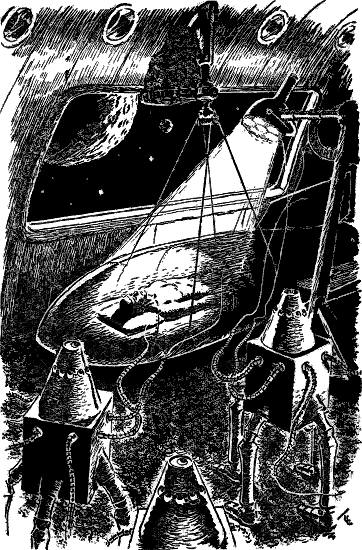
It glowed in a haze of light, the interior clearly revealed.

He had then soliloquized upon the possibility of preserving the human body in its state of death until the end of all earthly time—to that day when the earth would return to the sun from which it had sprung. Quite suddenly one day he had conceived the answer to the puzzling problem which obsessed his mind, leaving him awed with its wild, uncanny potentialities.

He would have his body shot into space enclosed in a rocket to become a satellite of the earth as long as the earth continued to exist. He reasoned logically. Any material substance, whether of organic or inorganic origin, cast into the depths of space would exist indefinitely. He had visualized his dead body enclosed in a rocket flying off into the illimitable maw of space. He would remain in perfect preservation, while on earth millions of generations of mankind would live and die, their bodies to molder into the dust of the forgotten past. He would exist in this unchanged manner until that day when mankind, beneath a cooling sun, should fade out forever in the chill, thin atmosphere of a dying world. And still his body would remain intact and as perfect in its rocket container as on that day of the far-gone past when it had left the earth to be hurled out on its career. What a magnificent idea!

At first he had been assailed with doubts. Suppose his funeral rocket landed upon some other planet or, drawn by the pull of the great sun, were thrown into the flaming folds of the incandescent sphere? Then the rocket might continue on out of the solar system, plunging through the endless seas of space for millions of years, to finally enter the solar system of some far-off star, as meteors often enter ours. Suppose his rocket crashed upon a planet, or the star itself, or became a captive satellite of some celestial body?

It had been at this juncture that the idea of his rocket becoming the satellite of the earth had presented itself, and he had immediately incorporated it into his scheme. The professor had figured out the amount of radium necessary to carry the rocket far enough away from the earth so that it would not turn around and crash, and still be not so far away but what the earth's gravitational attraction would keep it from leaving the vicinity of the earth and the solar system. Like the moon, it would forever revolve around the earth.

He had chosen an orbit sixty-five thousand miles from the earth for his rocket to follow. The only fears he had entertained concerned the huge meteors which careened through space at tremendous rates of speed. He had overcome this obstacle, however, and had eliminated the possibilities of a collision with these stellar juggernauts. In the rocket were installed radium repulsion rays which swerved all approaching meteors from the path of the rocket as they entered the vicinity of the space wanderer.

The aged professor had prepared for every contingency, and had set down to rest from his labors, reveling in the stupendous, unparalleled results he would obtain. Never would his body undergo decay; and never would his bones bleach to return to the dust of the earth from which all men originally came and to which they must return. His body would remain millions of years in a perfectly preserved state, untouched by the hoary palm of such time as only geologists and astronomers can conceive.

His efforts would surpass even the wildest dreams of H. Rider Haggard, who depicted the wondrous, embalming practices of the ancient nation of Kor in his immortal novel, "She," wherein Holly, under the escort of the incomparable Ayesha, looked upon the magnificent, lifelike masterpieces of embalming by the long-gone peoples of Kor.

With the able assistance of a nephew, who carried out his instructions and wishes following his death, Professor Jameson was sent upon his pilgrimage into space within the rocket he himself had built. The nephew and heir kept the secret forever locked in his heart.


Generation after generation had passed upon its way. Gradually humanity had come to die out, finally disappearing from the earth altogether. Mankind was later replaced by various other forms of life which dominated the globe for their allotted spaces of time before they too became extinct. The years piled up on one another, running into millions, and still the Jameson Satellite kept its lonely vigil around the earth, gradually closing the distance between satellite and planet, yielding reluctantly to the latter's powerful attraction.

Forty million years later, its orbit ranged some twenty thousand miles from the earth while the dead world edged ever nearer the cooling sun whose dull, red ball covered a large expanse of the sky. Surrounding the flaming sphere, many of the stars could be perceived through the earth's thin, rarefied atmosphere. As the earth cut in slowly and gradually toward the solar luminary, so was the moon revolving ever nearer the earth, appearing like a great gem glowing in the twilight sky.

The rocket containing the remains of Professor Jameson continued its endless travel around the great ball of the earth whose rotation had now ceased entirely—one side forever facing the dying sun. There it pursued its lonely way, a cosmic coffin, accompanied by its funeral cortege of scintillating stars amid the deep silence of the eternal space which enshrouded it. Solitary it remained, except for the occasional passing of a meteor flitting by at a remarkable speed on its aimless journey through the vacuum between the far-flung worlds.

Would the satellite follow its orbit to the world's end, or would its supply of radium soon exhaust itself after so many eons of time, converting the rocket into the prey of the first large meteor which chanced that way? Would it some day return to the earth as its nearer approach portended, and increase its acceleration in a long arc to crash upon the surface of the dead planet? And when the rocket terminated its career, would the body of Professor Jameson be found perfectly preserved or merely a crumbled mound of dust?


CHAPTER I

40,000,000 Years After

Entering within the boundaries of the solar system, a long, dark, pointed craft sped across the realms of space towards the tiny point of light which marked the dull red ball of the dying sun which would some day lie cold and dark forever. Like a huge meteor it flashed into the solar system from another chain of planets far out in the illimitable Universe of stars and worlds, heading towards the great red sun at an inconceivable speed.

Within the interior of the space traveler, queer creatures of metal labored at the controls of the space flyer which juggernauted on its way towards the far-off solar luminary. Rapidly it crossed the orbits of Neptune and Uranus and headed sunward. The bodies of these queer creatures were square blocks of a metal closely resembling steel, while for appendages, the metal cube was upheld by four jointed legs capable of movement. A set of six tentacles, all metal, like the rest of the body, curved outward from the upper half of the cubic body. Surmounting it was a queer-shaped head rising to a peak in the center and equipped with a circle of eyes all the way around the head. The creatures, with their mechanical eyes equipped with metal shutters, could see in all directions. A single eye pointed directly upward, being situated in the space of the peaked head, resting in a slight depression of the cranium.

These were the Zoromes of the planet Zor which rotated on its way around a star millions of light years distant from our solar system. The Zoromes, several hundred thousand years before, had reached a stage in science, where they searched for immortality and eternal relief from bodily ills and various deficiencies of flesh and blood anatomy. They had sought freedom from death, and had found it, but at the same time they had destroyed the propensities for birth. And for several hundred thousand years there had been no births and few deaths in the history of the Zoromes.

This strange race of people had built their own mechanical bodies, and by operation upon one another had removed their brains to the metal heads from which they directed the functions and movements of their inorganic anatomies. There had been no deaths due to worn-out bodies. When one part of the mechanical men wore out, it was replaced by a new part, and so the Zoromes continued living their immortal lives which saw few casualties. It was true that, since the innovation of the machines, there had been a few accidents which had seen the destruction of the metal heads with their brains. These were irreparable. Such cases had been few, however, and the population of Zor had decreased but little. The machine men of Zor had no use for atmosphere, and had it not been for the terrible coldness of space, could have just as well existed in the ether void as upon some planet. Their metal bodies, especially their metal-encased brains, did require a certain amount of heat even though they were able to exist comfortably in temperatures which would instantly have frozen to death a flesh-and-blood creature.

The most popular pastime among the machine men of Zor was the exploration of the Universe. This afforded them a never ending source of interest in the discovery of the variegated inhabitants and conditions of the various planets on which they came to rest. Hundreds of space ships were sent out in all directions, many of them being upon their expeditions for hundreds of years before they returned once more to the home planet of far-off Zor.

This particular space craft of the Zoromes had entered the solar system whose planets were gradually circling in closer to the dull red ball of the declining sun. Several of the machine men of the space craft's crew, which numbered some fifty individuals, were examining the various planets of this particular planetary system carefully through telescopes possessing immense power.

These machine men had no names and were indexed according to letters and numbers. They conversed by means of thought impulses, and were neither capable of making a sound vocally nor of hearing one uttered.

"Where shall we go?" queried one of the men at the controls questioning another who stood by his side examining a chart on the wall.

"They all appear to be dead worlds, 4R-3579," replied the one addressed, "but the second planet from the sun appears to have an atmosphere which might sustain a few living creatures, and the third planet may also prove interesting for it has a satellite. We shall examine the inner planets first of all, and explore the outer ones later if we decide it is worth the time."

"Too much trouble for nothing," ventured 9G-721. "This system of planets offers us little but what we have seen many times before in our travels. The sun is so cooled that it cannot sustain the more common life on its planets, the type of life forms we usually find in our travels. We should have visited a planetary system with a brighter sun."

"You speak of common life," remarked 25X-987. "What of the uncommon life? Have we not found life existent on cold, dead planets with no sunlight and atmosphere at all?"

"Yes, we have," admitted 9G-721, "but such occasions are exceedingly rare."

"The possibility exists, however, even in this case," reminded 4R-3579, "and what if we do spend a bit of unprofitable time in this one planetary system—haven't we all an endless lifetime before us? Eternity is ours."

"We shall visit the second planet first of all," directed 25X-987, who was in charge of this particular expedition of the Zoromes, "and on the way there we shall cruise along near the third planet to see what we can of the surface. We may be able to tell whether or not it holds anything of interest to us. If it does, after visiting the second planet, we shall then return to the third. The first world is not worth bothering with."


The space ship from Zor raced on in a direction which would take it several thousand miles above the earth and then on to the planet which we know as Venus. As the space ship rapidly neared the earth, it slackened its speed, so that the Zoromes might examine it closely with their glasses as the ship passed the third planet.

Suddenly, one of the machine men ran excitedly into the room where 25X-987 stood watching the topography of the world beneath him.

"We have found something!" he exclaimed.

"What?"

"Another space ship!"

"Where?"

"But a short distance ahead of us on our course. Come into the foreport of the ship and you can pick it up with the glass."

"Which is the way it's going?" asked 25X-987.

"It is behaving queerly," replied the machine man of Zor. "It appears to be in the act of circling the planet."

"Do you suppose that there really is life on that dead world—intelligent beings like ourselves, and that this is one of their space craft?"

"Perhaps it is another exploration craft like our own from some other world," was the suggestion.

"But not of ours," said 25X-987.

Together, the two Zoromes now hastened into the observation room of the space ship where more of the machine men were excitedly examining the mysterious space craft, their thought impulses flying thick and fast like bodiless bullets.

"It is very small!"

"Its speed is slow!"

"The craft can hold but few men," observed one.

"We do not yet know of what size the creatures are," reminded another. "Perhaps there are thousands of them in that space craft out there. They may be of such a small size that it will be necessary to look twice before finding one of them. Such beings are not unknown."

"We shall soon overtake it and see."

"I wonder if they have seen us?"

"Where do you suppose it came from?"

"From the world beneath us," was the suggestion.

"Perhaps."


CHAPTER II

The Mysterious Space Craft

The machine men made way for their leader, 25X-987, who regarded the space craft ahead of them critically.

"Have you tried communicating with it yet?" he asked.

"There is no reply to any of our signals," came the answer.

"Come alongside of it then," ordered their commander. "It is small enough to be brought inside our carrying compartment, and we can see with our penetration rays just what manner of creatures it holds. They are intelligent, that is certain, for their space ship does imply as much."

The space flyer of the Zoromes slowed up as it approached the mysterious wanderer of the cosmic void which hovered in the vicinity of the dying world.

"What a queer shape it has," remarked 25X-987. "It is even smaller than I had previously calculated."

A rare occurrence had taken place among the machine men of Zor. They were overcome by a great curiosity which they could not allow to remain unsatiated. Accustomed as they were to witnessing strange sights and still stranger creatures, meeting up with weird adventures in various corners of the Universe, they had now become hardened to the usual run of experiences which they were in the habit of encountering. It took a great deal to arouse their unperturbed attitudes. Something new, however, about this queer space craft had gripped their imaginations, and perhaps a subconscious influence asserted to their minds that here they have come across an adventure radically unusual.

"Come alongside it," repeated 25X-987 to the operator as he returned to the control room and gazed through the side of the space ship in the direction of the smaller cosmic wanderer.

"I'm trying to," replied the machine man, "but it seems to jump away a bit every time I get within a certain distance of it. Our ship seems to jump backward a bit too."

"Are they trying to elude us?"

"I don't know. They should pick up more speed if that is their object."

"Perhaps they are now progressing at their maximum speed and cannot increase their acceleration any more."

"Look!" exclaimed the operator. "Did you just see that? The thing has jumped away from us again!"

"Our ship moved also," said 25X-987. "I saw a flash of light shoot from the side of the other craft as it jumped."

Another machine man now entered and spoke to the commander of the Zorome expedition.

"They are using radium repellent rays to keep us from approaching," he informed.

"Counteract it," instructed 25X-987.

The man left, and now the machine man at the controls of the craft tried again to close with the mysterious wanderer of the space between planets. The effort was successful, and this time there was no glow of repulsion rays from the side of the long metal cylinder.

They now entered the compartment where various objects were transferred from out the depths of space to the interplanetary craft. Then patiently they waited for the rest of the machine men to open the side of their space ship and bring in the queer, elongated cylinder.

"Put it under the penetration ray!" ordered 25X-987. "Then we shall see what it contains!"

The entire group of Zoromes were assembled about the long cylinder, whose low nickel-plated sides shone brilliantly. With interest they regarded the fifteen-foot object which tapered a bit towards its base. The nose was pointed like a bullet. Eight cylindrical protuberances were affixed to the base while the four sides were equipped with fins such as are seen on aerial bombs to guide them in a direct, unswerving line through the atmosphere. At the base of the strange craft there projected a lever, while in one side was a door which, apparently opened outward. One of the machine men reached forward to open it but was halted by the admonition of the commander.

"Do not open it up yet!" he warned. "We are not aware of what it contains!"

Guided by the hand of one of the machine men, a series of lights shone down upon the cylinder. It became enveloped in a haze of light which rendered the metal sides of the mysterious space craft dim and indistinct while the interior of the cylinder was as clearly revealed as if there had been no covering. The machine men, expecting to see at least several, perhaps many, strange creatures moving about within the metal cylinder, stared aghast at the sight they beheld. There was but one creature, and he was lying perfectly still, either in a state of suspended animation or else of death. He was about twice the height of the mechanical men of Zor. For a long time they gazed at him in a silence of thought, and then their leader instructed them.

"Take him out of the container."

The penetration rays were turned off, and two of the machine men stepped eagerly forward and opened the door. One of them peered within at the recumbent body of the weird-looking individual with the four appendages. The creature lay up against a luxuriously upholstered interior, a strap affixed to his chin while four more straps held both the upper and lower appendages securely to the insides of the cylinder. The machine man released these, and with the help of his comrade removed the body of the creature from the cosmic coffin in which they had found it.

"He is dead!" pronounced one of the machine men after a long and careful examination of the corpse. "He has been like this for a long time."

"There are strange thought impressions left upon his mind," remarked another.

One of the machine men, whose metal body was of a different shade than that of his companions, stepped forward, his cubic body bent over that of the strange, cold creature who was garbed in fantastic accoutrements. He examined the dead organism a moment, and then he turned to his companions.

"Would you like to hear his story?" he asked.

"Yes!" came the concerted reply.

"You shall, then," was the ultimatum. "Bring him into my laboratory. I shall remove his brain and stimulate the cells into activity once more. We shall give him life again, transplanting his brain into the head of one of our machines."

With these words he directed two of the Zoromes to carry the corpse into the laboratory.

As the space ship cruised about in the vicinity of this third planet which 25X-987 had decided to visit on finding the metal cylinder with its queer inhabitant, 8B-52, the experimenter, worked unceasingly in his laboratory to revive the long-dead brain cells to action once more. Finally, after consummating his desires and having his efforts crowned with success, he placed the brain within the head of a machine. The brain was brought to consciousness. The creature's body was discarded after the all-important brain had been removed.


CHAPTER III

Recalled to Life


As Professor Jameson came to, he became aware of a strange feeling. He was sick. The doctors had not expected him to live; they had frankly told him so—but he had cared little in view of the long, happy years stretched out behind him. Perhaps he was not to die yet. He wondered how long he had slept. How strange he felt—as if he had no body. Why couldn't he open his eyes? He tried very hard. A mist swam before him. His eyes had been open all the time but he had not seen before. That was queer, he ruminated. All was silent about his bedside. Had all the doctors and nurses left him to sleep—or to die?

Devil take that mist which now swam before him, obscuring everything in line of vision. He would call his nephew. Vainly he attempted to shout the word "Douglas," but to no avail. Where was his mouth? It seemed as if he had none. Was it all delirium? The strange silence—perhaps he had lost his sense of hearing along with his ability to speak—and he could see nothing distinctly. The mist had transferred itself into a confused jumble of indistinct objects, some of which moved about before him.

He was now conscious of some impulse in his mind which kept questioning him as to how he felt. He was conscious of other strange ideas which seemed to be impressed upon his brain, but this one thought concerning his indisposition clamored insistently over the lesser ideas. It even seemed just as if someone was addressing him, and impulsively he attempted to utter a sound and tell them how queer he felt. It seemed as if speech had been taken from him. He could not talk, no matter how hard he tried. It was no use. Strange to say, however, the impulse within his mind appeared to be satisfied with the effort, and it now put another question to him. Where was he from? What a strange question—when he was at home. He told them as much. Had he always lived there? Why, yes, of course.

The aged professor was now becoming more astute as to his condition. At first it was only a mild, passive wonderment at his helplessness and the strange thoughts which raced through his mind. Now he attempted to arouse himself from the lethargy.

Quite suddenly his sight cleared, and what a surprise! He could see all the way around him without moving his head! And he could look at the ceiling of his room! His room? Was it his room! No— It just couldn't be. Where was he? What were those queer machines before him? They moved on four legs. Six tentacles curled outward from their cubical bodies. One of the machines stood close before him. A tentacle shot out from the object and rubbed his head. How strange it felt upon his brow. Instinctively he obeyed the impulse to shove the contraption of metal from him with his hands.

His arms did not rise, instead six tentacles projected upward to force back the machine. Professor Jameson gasped mentally in surprise as he gazed at the result of his urge to push the strange, unearthly looking machine-caricature from him. With trepidation he looked down at his own body to see where the tentacles had come from, and his surprise turned to sheer fright and amazement. His body was like the moving machine which stood before him! Where was he? What ever had happened to him so suddenly? Only a few moments ago he had been in his bed, with the doctors and his nephew bending over him, expecting him to die. The last words he had remembered hearing was the cryptic announcement of one of the doctors.

"He is going now."

But he hadn't died after all, apparently. A horrible thought struck him! Was this the life after death? Or was it an illusion of the mind? He became aware that the machine in front of him was attempting to communicate something to him. How could it, thought the professor, when he had no mouth. The desire to communicate an idea to him became more insistent. The suggestion of the machine man's question was in his mind. Telepathy, thought he.

The creature was asking about the place whence he had come. He didn't know; his mind was in such a turmoil of thoughts and conflicting ideas. He allowed himself to be led to a window where the machine with waving tentacle pointed towards an object outside. It was a queer sensation to be walking on the four metal legs. He looked from the window and he saw that which caused him to nearly drop over, so astounded was he.

The professor found himself gazing out from the boundless depths of space across the cosmic void to where a huge planet lay quiet. Now he was sure it was an illusion which made his mind and sight behave so queerly. He was troubled by a very strange dream. Carefully he examined the topography of the gigantic globe which rested off in the distance. At the same time he could see back of him the concourse of mechanical creatures crowding up behind him, and he was aware of a telepathic conversation which was being carried on behind him—or just before him. Which was it now? Eyes extended all the way around his head, while there existed no difference on any of the four sides of his cubed body. His mechanical legs were capable of moving in any of four given directions with perfect ease, he discovered.

The planet was not the earth—of that he was sure. None of the familiar continents lay before his eyes. And then he saw the great dull red ball of the dying sun. That was not the sun of his earth. It had been a great deal more brilliant.

"Did you come from that planet?" came the thought impulse from the mechanism by his side.

"No," he returned.

He then allowed the machine men—for he assumed that they were machine men, and he reasoned that, somehow or other they had by some marvelous transformation made him over just as they were—to lead him through the craft of which he now took notice for the first time. It was an interplanetary flyer, or space ship, he firmly believed.

25X-987 now took him to the compartment which they had removed him to from the strange container they had found wandering in the vicinity of the nearby world. There they showed him the long cylinder.

"It's my rocket satellite!" exclaimed Professor Jameson to himself, though in reality every one of the machine men received his thoughts plainly. "What is it doing here?"

"We found your dead body within it," answered 25X-987. "Your brain was removed to the machine after having been stimulated into activity once more. Your carcass was thrown away."

Professor Jameson just stood dumfounded by the words of the machine man.

"So I did die!" exclaimed the professor. "And my body was placed within the rocket to remain in everlasting preservation until the end of all earthly time! Success! I have now attained unrivaled success!"

He then turned to the machine man.

"How long have I been that way?" he asked excitedly.

"How should we know?" replied the Zorome. "We picked up your rocket only a short time ago, which, according to your computation, would be less than a day. This is our first visit to your planetary system and we chanced upon your rocket. So it is a satellite? We didn't watch it long enough to discover whether or not it was a satellite. At first we thought it to be another traveling space craft, but when it refused to answer our signals we investigated."

"And so that was the earth at which I looked," mused the professor. "No wonder I didn't recognize it. The topography has changed so much. How different the sun appears—it must have been over a million years ago when I died!"

"Many millions," corrected 25X-987. "Suns of such size as this one do not cool in so short a time as you suggest."

Professor Jameson, in spite of all his amazing computations before his death, was staggered by the reality.

"Who are you?" he suddenly asked.

"We are the Zoromes from Zor, a planet of a sun far across the Universe."

25X-987 then went on to tell Professor Jameson something about how the Zoromes had attained their high stage of development and had instantly put a stop to all birth, evolution and death of their people, by becoming machine men.


CHAPTER IV

The Dying World

"And now tell us of yourself," said 25X-987, "and about your world."

Professor Jameson, noted in college as a lecturer of no mean ability and perfectly capable of relating intelligently to them the story of the earth's history, evolution and march of events following the birth of civilization up until the time when he died, began his story. The mental speech hampered him for a time, but he soon became accustomed to it so as to use it easily, and he found it preferable to vocal speech after a while. The Zoromes listened interestedly to the long account until Professor Jameson had finished.

"My nephew," concluded the professor, "evidently obeyed my instructions and placed my body in the rocket I had built, shooting it out into space where I became the satellite of the earth for these many millions of years."

"Do you really want to know how long you were dead before we found you?" asked 25X-987. "It would be interesting to find out."

"Yes, I should like very much to know," replied the professor.

"Our greatest mathematician, 459C-79, will tell it to you." The mathematician stepped forward. Upon one side of his cube were many buttons arranged in long columns and squares.

"What is your unit of measuring?" he asked.

"A mile."

"How many times more is a mile than is the length of your rocket satellite?"

"My rocket is fifteen feet long. A mile is five thousand two hundred and eighty feet."

The mathematician depressed a few buttons.

"How far, or how many miles from the sun was your planet at that time?"

"Ninety-three million miles," was the reply.

"And your world's satellite—which you call moon from your planet—earth?"

"Two hundred and forty thousand miles."

"And your rocket?"

"I figured it to go about sixty-five thousand miles from the earth."

"It was only twenty thousand miles from the earth when we picked it up," said the mathematician, depressing a few more buttons. "The moon and sun are also much nearer your planet now."


Professor Jameson gave way to a mental ejaculation of amazement.

"Do you know how long you have cruised around the planet in your own satellite?" said the mathematician. "Since you began that journey, the planet which you call the earth has revolved around the sun over forty million times."

"Forty—million—years!" exclaimed Professor Jameson haltingly. "Humanity must then have all perished from the earth long ago! I'm the last man on earth!"

"It is a dead world now," interjected 25X-987.

"Of course," elucidated the mathematician, "those last few million years are much shorter than the ones in which you lived. The earth's orbit is of less diameter and its speed of revolution is greatly increased, due to its proximity to the cooling sun. I should say that your year was some four times as long as the time in which it now takes your old planet to circumnavigate the sun.

"How many days were there in your year?"

"Three hundred and sixty-five."

"The planet has now ceased rotating entirely."

"Seems queer that your rocket satellite should avoid the meteors so long," observed 459C-79, the mathematician.

"Automatic radium repulsion rays," explained the professor.

"The very rays which kept us from approaching your rocket," stated 25X-987, "until we neutralized them."

"You died and were shot out into space long before any life occurred on Zor," soliloquized one of the machine men. "Our people had not yet even been born when yours had probably disappeared entirely from the face of the earth."

"Hearken to 72N-4783," said 25X-987, "he is our philosopher, and he just loves to dwell on the past life of Zor when we were flesh and blood creatures with the threat of death hanging always over our heads. At that time, like the life you knew, we were born, we lived and died, all within a very short time, comparatively."

"Of course, time has come to mean nothing to us, especially when we are out in space," observed 72N-4783. "We never keep track of it on our expeditions, though back in Zor such accounts are accurately kept. By the way, do you know how long we stood here while you recounted to us the history of your planet? Our machine bodies never get tired, you know."


"Well," ruminated Professor Jameson, giving a generous allowance of time. "I should say about a half a day, although it seemed scarcely as long as that."

"We listened to you for four days," replied 72N-4783.

Professor Jameson was really aghast.

"Really, I hadn't meant to be such a bore," he apologized.

"That is nothing," replied the other. "Your story was interesting, and if it had been twice as long, it would not have mattered, nor would it have seemed any longer. Time is merely relative, and in space actual time does not exist at all, any more than your forty million years' cessation of life seemed more than a few moments to you. We saw that it was so when your first thought impressions reached us following your revival."

"Let us continue on to your planet earth," then said 25X-987. "Perhaps we shall find more startling disclosures there."

As the space ship of the Zoromes approached the sphere from which Professor Jameson had been hurled in his rocket forty million years before, the professor was wondering how the earth would appear, and what radical changes he would find. Already he knew that the geographical conditions of the various continents were changed. He had seen as much from the space ship.

A short time later the earth was reached. The space travelers from Zor, as well as Professor Jameson, emerged from the cosmic flyer to walk upon the surface of the planet. The earth had ceased rotating, leaving one-half its surface always toward the sun. This side of the earth was heated to a considerable degree, while its antipodes, turned always away from the solar luminary, was a cold, frigid, desolate waste. The space travelers from Zor did not dare to advance very far into either hemisphere, but landed on the narrow, thousand-mile strip of territory separating the earth's frozen half from its sun-baked antipodes.

As Professor Jameson emerged from the space ship with 25X-987, he stared in awe at the great transformation four hundred thousand centuries had wrought. The earth's surface, its sky and the sun were all so changed and unearthly appearing. Off to the east the blood red ball of the slowly cooling sun rested upon the horizon, lighting up the eternal day. The earth's rotation had ceased entirely, and it hung motionless in the sky as it revolved around its solar parent, its orbit slowly but surely cutting in toward the great body of the sun. The two inner planets, Mercury and Venus, were now very close to the blood red orb whose scintillating, dazzling brilliance had been lost in its cooling process. Soon, the two nearer planets would succumb to the great pull of the solar luminary and return to the flaming folds, from which they had been hurled out as gaseous bodies in the dim, age-old past, when their careers had just begun.

The atmosphere was nearly gone, so rarefied had it become, and through it Professor Jameson could view with amazing clarity without discomfort to his eyes the bloated body of the dying sun. It appeared many times the size he had seen it at the time of his death, on account of its relative nearness. The earth had advanced a great deal closer to the great star around which it swung.

The sky towards the west was pitch black except for the iridescent twinkle of the fiery stars which studded that section of the heavens. As he watched, a faint glow suffused the western sky, gradually growing brighter, the full moon majestically lifted itself above the horizon, casting its pale, ethereal radiance upon the dying world beneath. It was increased to many times the size Professor Jameson had ever seen it during his natural lifetime. The earth's greater attraction was drawing upon the moon just as the sun was pulling the earth ever nearer itself.

This cheerless landscape confronting the professor represented the state of existence to which the earth had come. It was a magnificent spread of loneliness which bore no witness to the fact that it had seen the teeming of life in better ages long ago. The weird, yet beautiful scene, spread in a melancholy panorama before his eyes, drove his thoughts into gloomy abstraction with its dismal, depressing influence. Its funereal, oppressive aspect smote him suddenly with the chill of a terrible loneliness.

25X-987 aroused Professor Jameson from his lethargic reverie. "Let us walk around and see what we can find. I can understand how you feel in regard to the past. It is quite a shock—but it must happen to all worlds sooner or later—even to Zor. When that time comes, the Zoromes will find a new planet on which to live. If you travel with us, you will become accustomed to the sight of seeing dead, lifeless worlds as well as new and beautiful ones pulsating with life and energy. Of course, this world being your own, holds a peculiar sentimental value to you, but it is really one planet among billions."

Professor Jameson was silent.

"I wonder whether or not there are any ruins here to be found?" queried 25X-987.

"I don't believe so," replied the professor. "I remember hearing an eminent scientist of my day state that, given fifty thousand years, every structure and other creation of man would be obliterated entirely from off the earth's surface."

"And he was right," endorsed the machine man of Zor. "Time is a great effacer."

For a long time the machine men wandered over the dreary surface of the earth, and then 25X-987 suggested a change of territory to explore. In the space ship, they moved around the earth to the other side, still keeping to the belt of shadowland which completely encircled the globe like some gigantic ring. Where they now landed arose a series of cones with hollow peaks.

"Volcanoes!" exclaimed the professor.

"Extinct ones," added the machine man.

Leaving the space ship, the fifty or more machine men, including also Professor Jameson, were soon exploring the curiously shaped peaks. The professor, in his wanderings had strayed away from the rest, and now advanced into one of the cup-like depressions of the peak, out of sight of his companions, the Zoromes.


CHAPTER V

Eternity or Death


He was well in the center of the cavity when the soft ground beneath him gave way suddenly and he catapulted below into the darkness. Through the Stygian gloom he fell in what seemed to be an endless drop. He finally crashed upon something hard. The thin crust of the volcano's mouth had broken through, precipitating him into the deep, hollow interior.

It must have been a long ways to fall—or so it had seemed. Why was he not knocked senseless or killed? Then he felt himself over with three tentacles. His metal legs were four broken, twisted masses of metal, while the lower half of his cubic body was jammed out of shape and split. He could not move, and half of his six tentacles were paralyzed.

How would he ever get out of there? he wondered. The machine men of Zor might never find him. What would happen to him, then? He would remain in this deathless, monotonous state forever in the black hole of the volcano's interior unable to move. What a horrible thought! He could not starve to death; eating was unknown among the Zoromes, the machines requiring no food. He could not even commit suicide. The only way for him to die would be to smash the strong metal head, and in his present immovable condition, this was impossible.

It suddenly occurred to him to radiate thoughts for help. Would the Zoromes receive his messages? He wondered how far the telepathic messages would carry. He concentrated the powers of his mind upon the call for help, and repeatedly stated his position and plight. He then left his mind clear to receive the thought answers of the Zoromes. He received none. Again he tried. Still he received no welcoming answer. Professor Jameson became dejected.

It was hopeless. The telepathic messages had not reached the machine men of Zor. They were too far away, just as one person may be out of earshot of another's voice. He was doomed to a terrible fate of existence! It were better that his rocket had never been found. He wished that the Zoromes had destroyed him instead of bringing him back to life—back to this!

His thoughts were suddenly broken in upon.

"We're coming!"

"Don't give up hope!"

If the professor's machine body had been equipped with a heart, it would have sung for joy at these welcome thought impressions. A short time later there appeared in the ragged break of the volcano's mouth, where he had fallen through, the metal head of one of the machine men.

"We shall have you out of there soon," he said.


The professor never knew how they managed it for he lost consciousness under some strange ray of light they projected down upon him in his prison. When he came to consciousness once more, it was to find himself inside the space ship.

"If you had fallen and had smashed your head, it would have been all over with you," were the first thought impulses which greeted him. "As it is, however, we can fix you up first rate."

"Why didn't you answer the first time I called to you?" asked the professor. "Didn't you hear me?"

"We heard you, and we answered, but you didn't hear us. You see, your brain is different than ours, and though you can send thought waves as far as we can you cannot receive them from such a great distance."

"I'm wrecked," said the professor, gazing at his twisted limbs, paralyzed tentacles and jammed body.

"We shall repair you," came the reply. "It is your good fortune that your head was not crushed."

"What are you going to do with me?" queried the professor. "Will you remove my brains to another machine?"

"No, it isn't necessary. We shall merely remove your head and place it upon another machine body."

The Zoromes immediately set to work upon the task, and soon had Professor Jameson's metal head removed from the machine which he had wrecked in his fall down the crater. All during the painless operation, the professor kept up a series of thought exchanges in conversation with the Zoromes, and it seemed but a short time before his head surmounted a new machine and he was ready for further exploration. In the course of his operation, the space ship had moved to a new position, and now as they emerged 25X-987 kept company with Professor Jameson.

"I must keep an eye on you," he said. "You will be getting into more trouble before you get accustomed to the metal bodies."

But Professor Jameson was doing a great deal of thinking. Doubtlessly, these strange machine men who had picked up his rocket in the depths of space and had brought him back to life, were expecting him to travel with them and become adopted into the ranks of the Zoromes. Did he want to go with them? He couldn't decide. He had forgotten that the machine men could read his innermost thoughts.

"You wish to remain here alone upon the earth?" asked 25X-987. "It is your privilege if you really want it so."

"I don't know," replied Professor Jameson truthfully.


He gazed at the dust around his feet. It had probably been the composition of men, and had changed from time to time into various other atomic structures—of other queer forms of life which had succeeded mankind. It was the law of the atom which never died. And now he had within his power perpetual existence. He could be immortal if he wished! It would be an immortality of never-ending adventures in the vast, endless Universe among the galaxy of stars and planets.

A great loneliness seized him. Would he be happy among these machine men of another far-off world—among these Zoromes? They were kindly and solicitous of his welfare. What better fate could he expect? Still, a longing for his own kind arose in him—the call of humanity. It was irresistible. What could he do? Was it not in vain? Humanity had long since disappeared from the earth—millions of years ago. He wondered what lay beyond the pales of death—the real death, where the body decomposed and wasted away to return to the dust of the earth and assume new atomic structures.

He had begun to wonder whether or not he had been dead all these forty millions of years—suppose he had been merely in a state of suspended animation. He had remembered a scientist of his day, who had claimed that the body does not die at the point of official death. According to the claims of this man, the cells of the body did not die at the moment at which respiration, heart beats and the blood circulation ceased, but it existed in the semblance of life for several days afterward, especially in the cells of the bones, which died last of all.

Perhaps when he had been sent out into space in his rocket right after his death, the action of the cosmic void was to halt his slow death of the cells in his body, and hold him in suspended animation during the ensuing millions of years. Suppose he should really die—destroying his own brain? What lay beyond real death? Would it be a better plane of existence than the Zoromes could offer him? Would he rediscover humanity, or had they long since arisen to higher planes of existence or reincarnation? Did time exist beyond the mysterious portals of death? If not, then it was possible for him to join the souls of the human race. Had he really been dead all this time? If so, he knew what to expect in case he really destroyed his own brain. Oblivion!

Again the intense feeling of loneliness surged over him and held him within its melancholy grasp. Desperately, he decided to find the nearest cliff and jump from it—head-first! Humanity called; no man lived to companion him. His four metal limbs carried him swiftly to the summit of a nearby precipice. Why not gamble on the hereafter? 25X-987, understanding his trend of thought, did not attempt to restrain him. Instead, the machine man of Zor waited patiently.

As Professor Jameson stood there meditating upon the jump which would hurl him now into a new plane of existence—or into oblivion, the thought transference of 25X-987 reached him. It was laden with the wisdom born of many planets and thousands of centuries' experience.

"Why jump?" asked the machine man. "The dying world holds your imagination within a morbid clutch. It is all a matter of mental condition. Free your mind of this fascinating influence and come with us to visit other worlds, many of them are both beautiful and new. You will then feel a great difference.

"Will you come?"

The professor considered for a moment as he resisted the impulse to dive off the declivity to the enticing rocks far below. An inspiration seized him. Backing away from the edge of the cliff, he joined 25X-987 once more.

"I shall come," he stated.

He would become an immortal after all and join the Zoromes in their never-ending adventures from world to world. They hastened to the space ship to escape the depressing, dreary influence of the dying world, which had nearly driven Professor Jameson to take the fatal leap to oblivion.

THE END.