Thursday, February 14, 2013

"The Venus of Azombeii" (1931) by Clark Ashton Smith


"The Venus of Azombeii"

(c) 1931

by

Clark Ashton Smith


The statuette was not more than twelve inches in height, and represented a female figure that somehow reminded me of the Medicean Venus, despite many differences of feature and proportion. It was wrought of a black wood, almost as heavy as marble; and the unknown artist had certainly made the most of his material to suggest the admixture of a negroid strain with a type of beauty well-nigh classic in its perfection of line. It stood on a pedestal formed in imitation of a half-moon, with the cloven side of the hemisphere constituting the base. On studying it more closely, I found that the resemblance to the Venus de Medici was largely in the pose and in the curves of the hips and shoulders; but the right hand was more elevated than hers in its position, and seemed to caress the polished abdomen; and the face was fuller, with a smile of enigmatic voluptuousness about the heavy lips, and a sensuous droop to the deep eyelids, which were like the petals of some exotic flower when they fold beneath a sultry velvet evening. The workmanship was quite amazing and would not have been unworthy of the more archaic and primitive periods of Roman art.

My friend Marsden had brought the figurine with him on his return from Africa; and it stood always on his library table. It had fascinated me and had stirred my curiosity from the first; but Marsden was singularly reticent concerning it; and beyond telling me that it was of negro workmanship and represented the goddess of a little-known tribe on the upper Benuwe, in Adamawa, he had so far declined to gratify my inquisitiveness. But his very reserve, and something of significant import, even of emotional perturbation in his tone whenever we spoke of the statuette, had made me believe that a story hung thereon; and, knowing Marsden as I did, remembering his habitual reticence recurrently varied by outbursts of a well-nigh garrulous confidentiality, I felt sure that he would tell me the story in due time.

I had known Marsden ever since our school-days, for we had both been in the same year at Berkeley. He possessed few friends, and none, perhaps, who had been intimate with him as long as I. So no one was better fitted than I to perceive the inexplicable change that had come over him since his two years of traveling in Africa. This change was both physical and spiritual, and some of its features were of so subtle a character that one could hardly give them a name or seize upon them with any degree of clearness. Others, though, were all too plainly marked: the increase of Marsden's natural melancholia, turning now into fits of ferocious depression; and the woeful deterioration of his health, never too robust even in its prime, would have been noticeable to the merest acquaintance. I remembered him as being very tall and wiry, with a sallow complexion, black hair, and eyes of a clear azure blue; but since his return, he was far thinner than of old, and he stooped so much that he gave the impression of having actually lost in height; his features were shrunken and wrinkled, his skin had become corpse-like in its pallor, his hair was heavily sprinkled with gray, and his eyes had darkened in an unaccountable manner, as if they had somehow absorbed the mysteriously profound and sinister blue of tropic nights. In them, there burned a fire they had never before possessed — a macabre fire such as one would find in the eyes of a man consumed by some equatorial fever. Indeed; it often occurred to me that the readiest explanation of the change in Marsden was that he had been seized by some lethal sickness of the jungle, from which he had not yet fully recovered. But this he had always denied when I questioned him.

The more elusive alterations at which I have hinted were mainly mental, and I shall not try to define all of them. But one, in particular; was quite signal: Marsden had always been a man of undoubted courage and hardihood, with nerves that were unshakable in spite of his melancholic disposition; but now I perceived in him at times a queer furtiveness, an undefinable apprehensiveness quite at variance with his former character. Even in the midst of some trivial or commonplace conversation, a look of manifest fear would suddenly pass over his face, he would scrutinize the shadows of the room with an apprehensive stare, and would stop half-way in a sentence, apparently forgetting what he had started to say. Then, in a few moments, he would recover himself and go on with the interrupted speech. He had developed some odd mannerisms, too: one of them was, that he could never enter or leave a room without looking behind him, with the air of a man who fears that he is being followed or that some imminent doom is dogging his every footstep. But all this, of course, could have been explained as nervousness attendant upon, or resulting from, the illness that I suspected. Marsden himself would never discuss the matter; so after a few discreet suggestions that might have led him to unbosom himself, if he so wished,, I had tacitly ignored the visible changes in his manner and personality, But I sensed a real and perhaps tragic mystery, and felt also that the black figurine on Marsden's table was in some way connected with it. He had told me much concerning his trip to Africa, which had been undertaken because of a life-long fascination which that continent had held for him; but I knew intuitively that much more was being kept back.

One morning, about six weeks after Marsden's return, I called to see him, following several days of absence during which I had been extremely busy. He was living alone, with one servant, in the large house on Russian Hill, San Francisco, which he had inherited together with a considerable fortune from his parents, who were long dead. He did not come to answer my knock, as was his wont; and if my hearing were not exceptionally keen, I do not think I should have heard the feeble voice in which he called out, telling me to enter. Pushing open the door, I went through the hall into the library, from which his voice had issued, and found him lying on a sofa, near the table on which stood the black statuette. It was obvious to me at a glance that he was very ill; his thinness and pallor had increased to a shocking degree in the few days since I had seen him last, and I was immediately impressed by the singular fact that he had even shrunken more in stature than could be explained by the crouch of his shoulders. Everything about him had shriveled, and actually withered as if a flame were consuming him, and the form on the couch was that of a smaller man than my friend. He had aged, also, and his hair had taken on a new hoariness, as if white ashes had fallen upon it. His eyes were pitifully sunken, and they burned as embers burn in deep caverns. I could scarcely repress a cry of astonishment and consternation when I saw him.

"Well, Holly," he greeted me, "I guess my days are numbered. I knew the thing would get me in time — I knew it when I left the shores of the Benuwe with that image of the goddess Wanaôs for a keepsake... There are dreadful things in Africa, Holly — malignant lust, and corruption, and poison, and sorcery — things that are deadlier than death itself — at least, deadlier than death in any form that we know. Don't ever go there — if you have any care for the safety of body and soul."

I tried to reassure him, without paying ostensible heed to the more cryptic references, the more oracular hints in his utterance.

"There is some low African fever in your system." I said. "You should see a doctor — should, in fact, have seen one weeks or months ago. There's no reason why you shouldn't get rid of the trouble, whatever it is, now that you are back in America. But of course you need expert medical attention: you can't afford to neglect anything so insidious and obscure."

Marsden smiled — if the ghastly contortion of his lips could be called a smile. "It's no use, old man. I know my malady better than any doctor could know it. Of course, it may be that I have a little fever — that wouldn't be surprizing; but the fever isn't one that has ever been classified in medical lore. And there's no cure for it in any pharmacopoeia." .

With the last word, his countenance assumed a horrible grimace of pain, and seemed to shrivel before me like a sheet of paper that turns ashen with fire. He no longer appeared to notice my presence, and began to mutter brokenly, in tones of a peculiar huskiness, in a harsh, grating whisper, as if the very cords of his throat were involved in the same shrinking that affected his face. I caught most, if not all, of the words:

"She is dying, too — as I am — even though she is a living goddess.... Mybaloë, why did you drink the palm-wine?... You, too, will shrivel up, and suffer these gnawing, clawing tortures... Your beautiful body... how perfect, how magnificent it was!... You shrivel up in a few weeks, like a little old woman ... you will suffer the torments of hell-fire... Mybaloë! Mybaloë!"

His speech became an indistinct moaning, in which portions of words were now and then audible. He had all the aspect of a dying man: his whole body seemed to contract, as if all the muscles, all the nerves, even the very bones, were dwindling in size, were tightening to a locked rigidity; and his lips were drawn in a horrible rictus, showing a thin white line of teeth.

I ran to Marsden's dining-room, where I knew that a decanter full of old Scotch usually stood on the sideboard, and filled a sherry-glass with liquor. Hastening back, I succeeded, though with extreme difficulty, in forcing some of the strong spirit between his teeth. The effect was almost immediate: he revived into full consciousness, his facial muscles relaxed, and he no longer wore the look of tetanic agony that had possessed his whole body.

I'm sorry to have been such a bother," he said. "But the crisis is past for today... Tomorrow, though ... that'll be another matter." He shuddered, and his eyes were dark with the haunting of some incombatable horror.

I made him drink the remainder of the whisky, and going to the telephone, took the liberty of summoning a doctor whose abilities were personally known to both of us. My friend smiled a little, in grateful recognition of my solicitude, but shook his head.

"The end won't be so very far off now," he said. "I know the symptoms; it's a matter of a fortnight, or little more, when matters reach the point that they have reached today."

"But what is it?" I cried. The query was prompted by horror and solicitude, more than curiosity.

"You will learn soon enough," he replied, pointing to the library table with a forefinger of skeleton thinness. "Do you see that manuscript?"

Following his direction, I perceived on the table, close to the wooden statuette, a pile of written sheets, which, in my natural concern regarding Marsden's illness, I had not before noticed.

"You are my oldest friend," he went on, "and I have been aware for quite a while past that I owe you an explanation of certain things that have puzzled you. But the matters involved are so strange, and so peculiarly intimate, that I have been unable to bring myself to a frank confession face to face. So I have written for you a full narration of the final two months of my stay in Africa, concerning which I have spoken so little heretofore. You are to take it home with you when you leave; but I must beg you not to read the manuscript until after my death. I am sure I can trust you to respect my wishes in this regard. When you read it; you will learn the cause of my illness, and the story of the black figurine which has tantalized your curiosity so much."

A few minutes later, there came a knock on the door, and I went to answer it. As I expected, it was Dr. Pelton, who lived only a few blocks away, and who had left home immediately in reply to my summons. He was a brisk and confident type of person, with the air of habitual reassurance, of professional good cheer, that goes so far in building up a doctor's reputation for proficiency. But I could see beneath his manner an undertone of doubt, of real bafflement, as he examined Marsden.

'I'm not altogether sure what is wrong," he admitted, "but I think the trouble is mainly digestive and nervous. Doubtless the African climate, and the food, must have upset you quite radically. You will need a nurse, if there is any recurrence of the attack you have had today."

He wrote a prescription, and left shortly after. Since I had a pressing engagement, I was obliged to follow him in about half an hour, taking with me the manuscript that Marsden had indicated. But before going, I called a nurse by telephone, with Marsden's authority, and left her in charge, promising to return as soon as possible.

Of the fortnight that followed, with the frightful protracted agonies, the brief and illusory shifts for the better, the ghastly relapses that characterized my friend's condition, I can not bear to write a full account. I spent with him all the time I could spare, for my presence seemed to comfort him a little, except during the awful daily crises, when he was beyond all consciousness of his surroundings.
Toward the last, there were lengthening intervals of delirium, when he muttered wildly, or screamed aloud in. terror of things or persons visible only to himself. To be with him, to watch him, was an ordeal without parallel; and to me, the most dreadful thing about it all was the progressive shriveling, the perpetuaI diminution of Marsden's head and body, and the lessening of his very stature, which went on hour by hour and day by day with paroxysmal accompaniments of a suffering not to be borne by human flesh without lapsing into madness or oblivion... But I cannot enter into details, or describe the final stages; and I hardly dare even hint the condition in which he died and in which his body went to the undertaker. I can only say that in their extreme, their more than infantile dwarfage and devolution of form, the remains bore no likeness to anything that it would be permissible to name; also, that the task of the undertaker and the pall-bearers was phenomenally light... When the end came, I gave thanks to God for the belated mercy of my friend's death. I was completely worn out, and it was not until after the funeral that I summoned enough energy and resolution for a perusal of Marsden's manuscript.

The account was clearly written, in a fine, feline script, though the handwriting bore evidence of stress. and agitation toward the end. I transcribe the narrative hereunder, with no liberties of abridgment or amplification:

.............

I, Julius Marsden, have experienced ail my life the ineffable nostalgia of the far-off and the unknown. I have loved the very names of remote places, of antipodean seas and continents and isles. But I have never found in any other word even a tithe of the untellable charm that has lain inherent for me ever since childhood in the three syllables of the word Africa. They have conjured up for me, as by some necromantic spell, the very quintessence of ill mystery, of all romance, and no woman's name could have been dearer to me, or more eloquent of delight and allure, than the name of this obscure continent. By a happy dispensation, which, alas! does not invariably attend the fulfilment of our dreams, my twenty-two months of sojourning in Morocco, Tunis, Egypt, Zanzibar, Senegal, Dahomey and Nigeria had in no way disappointed me, for the reality was astoundingly like my vision. In the hot and heavy azure of the skies, the great leveh of desert sand or of rampant jungles, the long and mighty rivers winding through landscapes of unbelievable diversity, I found something that was deeply congenial to my spirit. It was a realm in which my rarest dreams could dwell and expand with a sense of freedom never achievable elsewhere.

At the end of the twenty-second month of my sojourn, I was traveling on the upper reaches of the river Benuwe, that great eastern tributary of the Niger. My immediate objective was Lake Tchad, with whose confluent rivers the Benuwe is connected by means of an upland swamp. I had left Yollah, with several boatmen of the Foulah tribe, a race of negroid Mohammedans, and we had now rounded the eastern slope of Mount Alantika, that enormous granite bulk that looms for nine thousand feet from the fertile plains of Adamawa.

It was a picturesque and beautiful country through which we were passing. There were occasional villages surrounded by fields of durra, of cotton yams, and great stretches of wild, luxuriant forest, or baobabs, bananas, deleb-palms, pandanus and plaintains, beyond which arose the castellated tops of ridgy hills and fantastically carven cliffs.

Toward sunset, Alantika had become a bluish blur in the distance, above the green sea of the jungle. As we went onward in our two small barges, one of which was mainly laden with my personal effects, I perceived that my boatmen were conversing among themselves in low voices, and caught a frequent repetition of the word "Azombeii," always with a note of fear and warning.

I had aheady picked up a little of the Foulah language; and one of the boatmen, a tall, well-featured fellow, bronze rather than black, was master of a sort of broken German variegated with a few words of English. I questioned him as to the subject and import of the conversation, and learned that Azombeii was the name of the district we were now approaching, which, he declared, was peopled by a pagan tribe of unusual ferocity, who were still suspected of cannibalism and human sacrifice. They had never been properly subdued, either by the Mohammedan conquerors of the country or by the present German administration, and lived very much to themselves in their own primeval way, worshipping a goddess named Wanaôs — a goddess unfamiliar to the other pagan tribes of Adamawa, who were all fetishists. They were especially inimical toward the Mohammedan negroes, and it was perilous to intrude upon their territory, particulary during the annual religious festival now being celebrated. He and his fellows, he confessed, were loath to proceed much farther.

On all this, at the time, I made no express comment. To me, the story seemed none too credible, and savored of the ignorant prejudice of insular peoples, who are ever suspicious and fearful of those beyond their own borders. But I was a little disturbed, for I did not want the course of my journey to be suspended by any difficulty with my boatmen or the natives.

The sun had now gone down with a tropical abruptness, and in the brief twilight I saw that the forest on the river-banks had become more dense and exuberant than any through which we had before passed. There were ancient baobabs, enormous in the gloom; and the pendant leaves of mammoth plants fell down to the river like cataracts of emerald. Over all, a primordial silence reigned — a silence fraught with the burden of things unutterable by human speech — with the furtive pulse of an esoteric and exotic life, the secret breathing of unformulable passion, of unapprehended peril, the spirit of a vast and insuppressible fecundity.

We landed on a grassy margin, and proceeded to make our camp for the night. After a meal of yams and ground-nuts and tinned meat, to which I added a little palm-wine, I brought up the matter of continuing our journey on the morrow; but not until I had pledged myself to triple the boatmen's wages would they promise to take me through the Azombeii country. I more than ever inclined to make light of their fears, and, in fact, had begun to suspect that the whole business was mere play-acting, with no other purpose than the extortion of an increase of pay, But this, of course, I could not prove; and the boatmen were full of an apparent reluctance, vowing by Allah and his prophet Mohammed that the danger they would incur was incomparably dire — that they, and even myself, might furnish soup-meat for the revels of Azombeii, or smoke on a pagan altar, before the setting of tomorrow's sun. They also told me some curious details concerning the customs and beliefs of the people of Azombeii. These people, they said, were ruled by a woman who was looked upon as the living representative of the goddess Wanaôs, and who shared the divine honors accorded to her.

Wanaôs, as far as I could gather, appeared to be a goddess of love and procreation, resembling somewhat in her character both the Roman Venus and the Carthaginian Tanit. I was struck even then by a certain etymological similarity of her name to that of Venus -a similarity regarding which I was soon to learn more. She was worshipped, they told me, with rites and ceremonies of an orgiastic license beyond all parallel — a license which shocked even the neighboring pagans, who were themselves given to vile practises not to be tolerated by any virtuous Moslem. They went on to say that the Azombeiians were also addicted to sorcery, and that their witch-doctors were feared throughout Adamawa.

My curiosity was aroused, though I told myself that in all probability the rumors related by the boatmen were fables or gross exaggerations. But I had seen something of negro religious rites, and was able to credit the tales of orgiastic excess, at any rate. Pondering the strange stories I had heard, my imagination became excited, and I did not fall asleep till after an unwonted interval.

My slumber was heavy, and full of troubled dreams that appeared to prolong intolerably the duration of the night. I awoke a little before dawn, when the red horn of a waning moon had begun to set behind the separate edges of palm-trees in the west. Looking about in the half-light, with eyes that were still bemused with sleep, I found myself entirely alone: The boatmen and their barges were gone, though all of my personal property and some of the provisions had been left behind with an honesty quite scrupulous, considering the circumstances. Evidently the fears expressed by the Foulahs had been genuine, and discretion had overpowered their desire for gain.

Somewhat dismayed by the prospect of having to continue my journey alone — if it were to be continued at all — and without means of navigation or conveyance, I stood irresolute on the river-bank, as the dawn began to brighten. I did not like the idea of turning back; and, since I did not consider it at all probable that I could be in any bodily danger at the hands of the natives, in a region under German rule, I finally resolved to go on and try to engage bearers or boatmen in the Azombeii district. It would be necessary for me to leave most of my effects by the river for the present, and return for them later, trusting to find them undisturbed.

I had no sooner made up my mind to this course of procedure, than I heard a soft rustling in the long grasses behind me. Turning, I perceived that I was no longer alone, though my companions were not the Foulahs, as I had hoped for a brief instant. Two negro women, attired in little more than the lightening amber air of morn, stood close beside me. Both were fairly tall, and well-proportioned, but it was the foremost of the two who caught my attention with a veritable shock of surprize not altogether due to the suddenness of her approach.

Her appearance would have surprized me anywhere, at any time. Her skin was a lustrous velvet black, with subtle gleams of rapid-running bronze; but all her features and proportions, by some astounding anomaly, were those of an antique Venus. Indeed, I have seldom seen in Caucasian women a more consummate regularity of profile and facial coutour. As she stood before me without moving, she might have been a woman of Rome or Pompeii, sculptured in black marble by a statuary of the Latin decadence. She wore a look that was both demure and sensual, an expression full of cryptic poise allied with great sweetness. Her hair was done in a rich coil on the nape of a comely neck. Between her breasts, on a chain of beaten silver, hung several ruddy garnets, carven with rough intaglios whose precise nature I did not notice at the time. Her eyes met mine with perfect frankness, and she smiled with an air of naive delight and mischief at my all-too-obvious dumfoundment. That smile made me her voluntary captive henceforward.

The second woman was of a more negroid type, though personable enough in her way. By her bearing and demeanor, she gave the impression of being somehow subordinate to the first, and I assumed that she was a slave or servant. The one semblance of a garment worn by both was a little square of cloth de- pending in front from a girdle of palm-fiber; but the fabric of the square worn by the first was finer than that of the other, and differed from it in having a fringe of silky tassels.

The leader turned and spoke a few words to her companion in mellifluous liquid tones, and the servant replied in a voice ahnost equally soft and musical; The word "Aroumani" was repeated several times, with accompanying glances at me, and I readily surmised that I was the theme of their conversation. I could not understand their speech, which bore no likeness to the Foulah language, and, indeed, was different from that of any pagan tribe I had so far encountered in Adamawa. But some of the vocables teased me with a vague sense of familiarity, though I could not define or aline this familiarity at the moment.

I addressed the two women in the scant Foulah that I knew, asking if they were of the Azombeii tribe. They smiled, and nodded their heads in recognition of the word, and made signs to me that I was to follow them.

The sun had now leapt above the horizon, and the forest was filled with a great and golden radiance as the women led me away from the river-shore and along a meandering path among gigantic baobabs. They walked before me with a grave and effortless grace, and the leader looked back every now and then over her shapely shoulder, smiling with a complaisant curve of the full lips and a delicious droop of the carven lids that had in them a trace of simple coquetry. I followed, half overcome by emotions that were new to me — by the first pulsations of a mounting fever of the senses and the mind, the stirring of unfamiliar curiosities, the subtle or, the poppy-drowsy delight of a Circean enchantment. I felt as if the immemorial attraction of Africa had suddenly become embodied for me in a human shape.

The forest began to thin, and we came to cultivated fields, and then to a large village of clay huts. My sable guides pointed to the village, saying the one word: "Azombeii," which, as I learned later, was the name of the principal town as well as of the district in general.

The place was astir with negroes, many of whom, both male and female, were possessed of a clear-cut type of feature unaccountably reminiscent of the classical, and similar to that of the two women. Their skins varied from darkest ebony to a sultry, tarnished copper. Many of them crowded around us immediately, regarding me with a sort of friendly inquisitiveness, and making signs of obeisance and reverence before my Venuslike companion. It was clear that she occupied a place of high importance among them, and I wondered, not for the first time, if she were the woman of whom the Foulahs had spoken — the ruler of the Azombeii and the living viceregent of the goddess Wanaôs.

I tried to converse with the natives, but could not make myself understood until an old man with a bald head and a straggling fringe of gray beard came forward and hailed me in broken English. He, it seemed, had traveled as far afield as Nigeria during his youth, which accounted for his linguistic accomplishments. None of the others had ever been more than a few miles beyond the confines of his own territory; and apparently the tribe had little intercourse with outsiders, either negro or Caucasian.

The old man was most affable and loquacious, evidently delighting in an opportunity to air his command of a foreign tongue. It was hardly necessary to question him, for he began at once to volunteer the information which I desired. His people, he announced, were very glad to see me, for they were friendly toward the whites, though they had no manner of use for the Moslem negroes of Adamawa. Also, he went on, it was manifest that I had won the favor and protection of the goddess Wanaôs, since I appeared among them under the guidance of Mybaloë, their beloved ruler, in whom the spirit of the goddess resided. At this, he made an humble obeisance toward my lovely guide, who smiled, and addressed a few sentences to him, which he forthwith interpreted, saying that Mybaloë had proffered me an invitation to remain in Azombeii as her guest.

I had intended to broach immediately the matter of hiring bearers, or engaging boatmen for the continuance of my journey on the Benuwe; but at this invitation, and the sweet, wistful, almost supplicating look which Mybaloë directed upon me as her words were being translated, I forgot all about my plans, and told the interpreter to thank Mybaloë and say that I accepted the invitation. A few hours earlier, I should not have dreamt of the possibility of feeling any specific interest in a black woman, since that aspect of the charm of Africa was one which had never really touched me heretofore. But now, the first weavings of an unforeseen magic were upon me: my senses had become preternaturally active, and my normal processes of thought were benumbed as by the working of some insidious opiate. I had been eager to reach Lake Tchad, and the idea of tarrying by the way had never before occurred to me: now, it seemed the most natural thing in the world to remain in Azombeii, and Lake Tchad became a dimly receding mirage, far off on the borders of oblivion.

Mybaloë's face grew radiant as a summer morn, when my acceptance was interpreted. She spoke to some of the people about her, obviously giving them instructions. Then she disappeared into the crowd, and the old interpreter, with several others, led me to a hut which they put at my disposal. The hut was quite clean, and the floors were strewn with strips of palm-leaf, which exhaled an agreeable odor. Food and wine were set before me and the old man and two girls remained in attendance, saying that they had been appointed as my servants. I had barely finished my meal, when some more natives entered, bearing the belongings I had left by the river-side.

Now, in reply to my queries, the interpreter, whose name was Nygaza, told me as much as his rudimentary English would convey regarding the history, habits and religion of the people of Azombeii. According to their traditions, the worship of Wanaôs among them was almost as old as the world itself, and had been introduced ages and ages ago by some white strangers from the north, who called themselves Aroumani. These strangers had settled and married among the natives, and their blood had gradually become disseminated throughout the whole, tribe, who had always remained apart from the other pagans of Adamawa. All white people were called Aroumani by them, and were looked upon with peculiar respect, on account of these traditions. Wanaôs, as the Foulahs had said, was a deity of love and fecundation, the mother of all life, the mistress of the world, and her image had been accurately graven in wood by the pale strangers, so that the Azombeiians might have an exemplar for their idol. It had always been customary to associate a living woman with her worship, as a sort of avatar or embodiment of the goddess, and the most beautiful maiden of the district was chosen by the priests and priestesses for this rôle, and filled also the office of queen, with the privilege of taking to herself a male consort. Mybaloë, a girl of eighteen, had recently been elected; and the annual festival of Wanaôs, which consisted of liberal drinking and feasting, together with nightly ceremonies of worship, was now in progress.

While I listened to the old man, I indulged in certain speculations of a surprizing order. I deemed it not impossible that the pale strangers of whom he spoke had been a party of Roman explorers, who had crossed the Sahara from Carthage and penetrated the Sudan. This would account for the classic features of Mybaloë and others of the Azombeiians, and for the name and character of the local goddess. Also, the vague familiarity of some of the words spoken by Mybaloë was now explicable, since I realized that these words had borne a partial resemblance to Latin vocables. Much amazed by what I had learned and by all that I had succeeded in piecing together, I lost myself in odd reveries, while Nygaza continued his babbling.

The day wore on, and I did not see Mybaloë, as I had fully expected, nor did I receive word from her. I began to wonder a little. Nygaza said that her absence was attributable only to urgent duties; he leered discreetly, as he assured me that I would soon see her again.

I went for a walk through the village, accompanied by the interpreter and the girls, who refused to leave me for a moment. The town, as I have said, was large for an African village, and must have comprised two or three thousand people. All was neat and orderly, and general degree of cleanliness was quite remarkable. The Azombeiians, I could see, were thrifty and industrious, and gave evidence of many civilized qualities.

Toward the hour of sunset, a messenger came, bearing an invitation from Mybaloë, which Nygaza translated. I was to dine with her in her palace, and then attend the evening rites in the local temple.

The palace stood on the very outskirts of the town, among palms and pandanus, and was merely an overgrown hut, as African palaces are wont to be. But the interior proved to be quite comfortable, even luxurious, and a certain barbaric taste had been displayed in its furnishing. There were low couches along the walls, covered with draperies of native weaving, or the skins of the ayu, a sort of fresh-water seal found in the Benuwe. In the center was a long table, not more than a foot in height from the floor, around which the guests were squatted. In one corner, as in a niche, I noticed a small wooden image of a female figure, which I rightly took to be a representation of Wanaôs. The figure bore a strange resemblance to the Roman Venus; but I need not describe it further, since you have often seen it on my library table.

Mybaloë greeted me with many compliments, which were duly translated by Nygaza; and I, not to be outdone, replied with speeches of a flowery fervor by no means insincere. My hostess had me seated at her right hand, and the feast began. The guests, I learned, were mostly priests and priestesses of Wanaôs. All of them regarded me with friendly smiles, with the exception of one man, who wore a murderous frown.

This man, Nygaza told me in a whisper almost inaudible, was the high-priest Mergawe, a mighty sorcerer or witch-doctor, much feared rather than revered, who had long been in love with Mybaloë and had hoped to be chosen for her consort.

As unobtrusively as I could, I surveyed Mergawe with more attention. He was a muscular brute, over six feet in height, and broad without being stout. His face was regular in outline, and would have been handsome, were it not for the distortion due to a most malignant expression. Whenever Mybaloë smiled upon me or addressed some remark to me through Nygaza, his look became a demoaiacal glare. I readily perceived that the first day of my visit in Azombeii had brought me a powerful enemy, as well as a possible sweetheart.

The table was laden with equatorial delicacies, with the meat of young rhinoceros, several kinds of wild fowl, bananas, papayas, and a sweet, highly intoxicating palm-wine. Most of the guests were prone to gorge themselves in true African fashion, but Mybaloë's manner of eating was as dainty as that of any European girl, and she endeared herself to me all the more by her restraint, Mergawe also ate little, but drank immoderately, in a seeming attempt to achieve inebriation as soon as possible. The eating and drinking went on for hours, but I paid less and less attention to it and to my fellow-guests, in the ever-growing enchantment of Mybaloë's presence. Her sinuous youthful grace of figure, her lovely tender eyes and lips, were far more potent than the wine, and I soon forgot to notice even the baleful glaring of Mergawe. On her part, Mybaloë displayed toward me a frank favor, swiftly conceived and avowed, which she did not even dream of disguising. She and I began to speak a language which did not require the interpretation of old Nygaza. With the one exception of Mergawe, no one seemed to regard our mutual infatuation with anything but approval.

Presentiy the time of the evening rites approached, and Mybaloë excused herself, telling me that she would meet me later in the temple, The gathering broke up, and Nygaza led me through the nocturnal village, where groups of people were feasting and revelling about their fires in the open air. We entered the jungle, which was full of voices and flitting shadowy forms, all on their way to the fane of Wanaôs. I had no idea what the temple would be like, though somehow I did not expect the usual African fetish-house. To my surprize, it proved to be an enornous cave in a hill back of the village. It was illumined by many torches, and had already become crowded with the worshippers. At the farther end of the huge chamber, whose lofty vault was dark with impenetrable shadow, there stood on a sort of natural dais an image of Wanaôs, carved in the customary black wood of a tree that is native to Azombeii. The image was somewhat more than life-size. Beside it, on a wooden seat that could easily have accommodated another person, sat Mybaloë, statuesque and immobile as the goddess herself. Fragrant leaves and grasses were burning on a low altar, and tom-toms were throbbing with delirious insistence, regular as the beating of turgid pulses, in the gloom behind the goddess and her mortal viceregent. The priests, priestesses and devotees were all naked, except for little squares of doth similar to that worn by Mybaloë, and their bodies gleamed like polished metal in the wildly flickering light of the torches. All were chanting a solemn monotonous litany, and they swayed in the slow movements of a hieratic dance, lifting their arms toward Wanaôs, as if to invoke her favor.

There was an undeniable impressiveness about it all; and as if by contagion, a bizarre excitement began to invade me, and something of the sacred fervor felt by the devotees found its way into my own blood. With eyes intent upon Mybaloë, who seemed to be in a veritable trance, unconscious or unheedful of all about her, I felt the resurgence of atavistic impulses, of barbaric passions and superstitions, latent in the subterranean depths of being. I knew the promptings of a savage hysteria, of a lust both animal and religious.

The old interpreter, who had disappeared in the throng, returned to my side anon, saying that Mybaloë had requested that I come forward to her seat, How the request had been communicated I can not imagine, for surely her lips had never opened or moved beneath my intent and passionate watching. The worshippers made way for me, and I stood before her, thrilling almost with a kind of awe, as well as a frenetic desire, when I met her eyes that were filled by the solemn possession of the amorous deity. She motioned me to seat myself beside her. By this act, as I learned later, she selected me before all the world as her consort, and I, by accepting the invitation, became her official lover.

Now, as if my enthronement with Mybaloë were a signal, the ceremonies took on a new excitation, with an orgiastic trend at which I can only hint. Things were done at which Tiberias would have blushed: Elephantis itself could have learned more than one secret from these savages. The cavern became a scene of indiscriininate revel, and the goddess and her representative were alike forgotten in the practise of rites that were doubtless appropriate enough, considering the nature of Wanaôs, even though they were highly improper from a civilized viewpoint. Through it all, Mybaloë maintained a perfect immobility, with open eyes whose lids were still as those of the statue. At last she arose and looked around the cavern upon her oblivious devotees with a gaze that was wholly inscrutable. Then she turned to me, with a demure smile and a slight movement of the hand, and beckoned me to follow her. Unnoticed by any one, we left the orgies and came forth upon the open jungle, where warm gusts of perfume wandered beneath the tropical stars....

From that night there began for me a new life — a life which I will not try to defend, but will only describe, as far as any description is possibie. I had never before conceived of anything of the sort; I should never have believed myself capable of the sensuous fervor I felt for Mybaloë, and the almost inenarrable experiences into which her love initiated me. The dark electric vitality of the very earth upon which I trod, the humid warmth of the atmosphere, the life of the swiftly growing luxuriant plants, all became an intimate part of my own entity, were mingled with the ebb and flow of my blood, and I drew nearer than ever before to the secret of the charm that had lured me across the world to that esoteric continent. A powerful fever exalted all my senses, a deep indolence bedrugged my brain. I lived, as never before, and never again, to the full capacity of my corporeal being. I knew, as an aborigine knows, the mystic impact of perfume and color and savor and tactual sensation. Through the flesh of Mybaloë, I touched the primal reality of the physical world. I had no longer any thoughts, or even dreams, in the abstract meaning of such terms, but existed wholly in relation to my surroundings, to the diurnal flux of light and darkness, of sleep and passion, and all sensory impressions.

Mybaloë, I am sure, was indeed lovable, and her charm, though highly voluptuous, was not altogether of the body. She had a fresh and naive nature, laughter loving and kindly, with less of actual or latent cruelty than is common to the African. And always I found in her, even apart from her form and features, a delightful suggestion of the elder pagan world, a hint of the classic woman and the goddess of old myths. Her sorcery, perhaps, was not really complex; but its power complete, and lay as far beyond analysis as beyond denial. I became the ecstatic slave of a loving and indulgent queen.

The flowers of an equatorial spring were now in bloom, and our nights were opiate or aphrodisiac with their fragrance. The nocturnal heavens were full of fervid stars, the moons were balmy and propitious, and the people of Azombeii looked with favor upon our love, since the will of Mybaloë was to them the will of the goddess.

One cloud alone — a cloud which we scarcely regarded at first — was visible in our firmament. This cloud was the jealousy and ill-will of Mergawe, the high-priest of Wanaôs. He glowered with a lethal malignity, sullen as a negro Satan, whenever I happened to meet him; but his ill-will was not otherwise demonstrated, either by word or act; and Nygaza and Mybaloë both assured me that overt hostility on his part would be most improbable at any time, since, because of Mybaloe's divine office and my position as her lover, anything of the sort would savor of actual blasphemy.

As for me, I felt an intuitive distrust of the sorcerer, though I was far too happy to expend much thought on the problem of his potential maleficence. However, the man was an interesting type, and his reputation was literally something with which to conjure. People believed that he knew the language of animals, and could even hold converse with trees and stones, which accorded him whatever information he might require. He was reputed to be a master of what is known as "bad fetish" — that is to say, he could lay an evil spell on the person or possessions of whosoever had incurred his enmity. He was a practitioner of invultuation, and was also said to know the secret of a terrible slow poison, which caused its victims to wither up and shrivel to the statue of a new-born child, with prolonged and hellish agonies — a poison which did not begin to operate for weeks or even months after the time of its consumption.

The days went by, and I lost all proper count of their passage, reckoning time only by the hours I spent with Mybaloë. The world and its fullness were ours -ours were the deep-blue heavens and the flowering forest and the grassy meadows by the riverside. As lovers are prone to do, we found for ourselves more than one favorite haunt, to which we liked to repair at recurrent intervals. One of these haunts was a grotto behind the cave-temple of Wanaôs, in whose center was a great pool fed by the river Benuwe through subterranam channels. At some remote time, the roof of the grotto had broken in, leaving a palm-fringed aperture in the hill-top, through which the sunlight or moonlight fell with precipitate rays upon the somber waters. Around the sides there were many broad ledges and fantastic dcoves of columnar stone. It was a place of weird beauty, and Mybaloë and I had spent more than one moon-lit hour on the couch-like shelves above the pool. were inhabited by several crocodiles, but of these we took little heed, absorbed in each other and in, the bizarre loveliness of the grotto, that always changed with the changing light.

One day, Mybaloë had been summoned away from the village on some errand whose nature I can not now remember. Doubtless it concerned some problem of justice or native politics. At any rate, she was not expected back till the following noon. Therefore, I was quite surprized when a messenger came to me at evening, with word that Mybaloe would return sooner than she had planned, and that she requested me to meet her in the grotto behind the cave of Wanaos at the hour when the rays of the moon, now slightly gibbous, would first fall through the opening above. The native who brought the message was a man I had never seen before, but of this I thought nothing, since he purported to come from the outlying village to which Mybaloë had been called.

I reached the cavern at the hour appointed, and paused on the verge of one of the ledges, looking about in the uncertain light for Mybaloë. The moon had begun to pour a faery radiance over the rough edge of the pit in the cavern-dome. I saw a stealthy movement in the waters beneath me, where a crocodile slid through the silver-gleaming ebony of the surface; but of Mybaloë herself I could find no visible sign anywhere. I wondered if she were not hiding from me in some prankish mood, and resolved to make a search of the alcoves and shelves on tiptoe, in order to surprize her.

I was about to leave the ledge on which I stood, when I received a violent push from behind; which precipitated me with a headlong suddenness into the black pool seven or eight feet below. The waters were deep, and I sank almost to the bottom before I recovered myself or even realized what had happened. Then I rose and struck out blindly for the shore, remembering with a thrill of terror the crocodile I had seen a moment before my fall. I reached the edge, where it shelved down with accessible gradations, but the water was still deep, and my fingers slipped on the smooth stone. Behind me, I heard a furtive rippling, and knew its causation all too well. Turning my head, I saw two of the great saurians, whose eyes burned with unholy phosphorescence in the moonlight as they glided toward me.

I think that I must have cried aloud; for, as if in answer, I heard a woman's voice cry out on the ledge above, and then the rippled waters were cleft by a falling form that shone for an instant with a flash as of black marble. A breathless interval, while the waters foamed, and then a well-known head arose beside me, and an arm that held aloft a glittering knife. It was Mybaloë herself. With miraculous adroitness, she drove the knife to its hilt in the side of the foremost crocodile, as the monster opened his formidable jaws to seize me. Her stroke had found the heart, and the crocodile slipped back beneath the surface, thrashing about in a brief agony. But its companion came on without pausing, and met the same unerring thrust of Mybaloë knife. There were stirrings in the pool, and the dark bodies of others began to appear. With a superhuman agility, in what was seemingly no more than a single movement, Mybaloë drew herself out on the rocks of the margent, and caught my hands in hers. An instant more, and I stood beside her, hardly knowing how I had come there, so light and swift had been my ascent. The crocodiles were nosing the shore beneath us when I turned to look back.

Breathless and dripping, we sat on a moon-bright shelf of the cavern and began to question each other, with tender interludes of silence and caresses. In a few weeks, I had learned much of the Azombeiian tongue, and we no longer required an interpreter at any time.

To my astonishment, Mybaloë denied having sent me a messenger that evening. She had. returned because of overwhelming premonition of some imminent evil that menaced me, and had felt herself drawn irresistibly to the grotto, arriving just in time to find me floundering in the pool. While passing through the cave of Wanaôs, from which a low tunnel led to the open grotto, she had met a man in the darkness, and thought that it might have been Mergawe. He had passed without speaking, in as much haste as Mybaloë herself. I told her of the push I had received from behind as I stood on the ledge. It was all too evident that I had been lured to the cavern by some one who desired to make away with me; and, as far as we knew, Mergawe was the one person in Azombeii capable of conceiving or nurturing such a motive. Mybaloë became very grave, and little more was said between us regarding the matter.

After our return to the village, Mybaloë sent several men to search for Mergawe and bring him before her. But the sorcerer had disappeared, and no one could tell his whereabouts, though more than one person had seen him earlier in the evening. He did not return to his dwelling on the morrow; and though a sedulous and thorough quest was instituted throughout the whole of Azombeii, no trace of him could be found during the days following. His very disappearance, of course, was taken for an implicit confession of guilt. Supreme indignation was rife among the people when the episode in the grotto became publicly known; and in spite of the fear his reputation had evoked, Mergawe would have fared disastrously at their hands, and the sentence of death pronounced against him by Mybaloë would have been needless, if he had dared to show himself among his fellow-tribesmen.

The unexpected peril I had faced, and the marvelous rescue effected by Mybaloë, served to draw us even closer together, and our passion found a new depth and gravity henceforward. But as time went on, and nothing was heard of Mergawe, who seemed to have been swallowed up by the wide and sultry silence of the equatorial spaces, the episode began to recede, and gradually dwindled to our view in a lengthening pereyective of blissful days. We ceased to apprehend any further attempt at harm on the part of the witch-doctor, and were lulled to an indolent security, in which our happiness took on the hues of its maturing summer.

One night, the priests of Wanaôs were giving a dinner in my honor. Forty or fifty people were already gathered in a banqueting-hall not far from the temple, but Mybaloë had not yet arrived. As we sat awaiting her, a man entered, bearing a large calabash full of palm-wine. The man was a stranger to me, though he was evidently known to some of the people present, who hailed him by name, calling him Marvasi.

Addressing me, Marvasi explained that he had been sent by the people of an outland community with a gift of palm-wine, which they hoped that I, as the consort of Mybaloë, would deign to accept. I thanked him, and bade him convey my acknowledgement to the donors of the wine.

"Will you not taste the wine now?" he said, "I must return immediately; but before leaving, I should like to learn if the gift meets with your approval, so that I can tell my people."

I poured out some of the wine into a cup and drank it very slowly, as one does in testing the savor and quality of a beverage. It was quite sweet and heavy, with a peculiar after-flavor of puckerish bitterness which I did not find altogether agreeable. However, I praised the wine, not wishing to hurt Marvasi's feelings. He grinned with apparent pleasure at my words, and was about to depart, when Mybaloë entered. She was panting with haste, her expression was both wild and stern, and her eyes blazed with unnatural fire. Rushing up to me, she snatched the empty wine-cup from my fingers.

"You have drunk it?" she cried, in a tone of statement more than of query.

"Yes," I replied, in great wonder and perplexity.

The look that she turned upon me was indescribable, and full of conflicting elements. Horror, agony, devotion, love and fury were mingled in it, but I knew somehow that the fury was not directed toward me. For one intense moment her eyes held mine; then, averting her face, she pointed to Marvasi and bade the priests of Wanaôs to seize and bind him. The command was instantly obeyed. But before offering any explanation, and without saying a word to me or to anyone, Mybaloë poured out a cupful of the palm-wine and drank it at a single draft. Beginning to suspect the truth, I would have seized it from her hand, but she was too quick for me.

"Now we will both die," she said, when she had emptied the cup. For a moment, her face assumed a tranquil smile, then it became the countenance of an avenging goddess as she turned her attention to the wretched Marvasi. Every one present had now surmised the truth, and mutterings of rage and horror were heard on all sides. Marvasi would have been torn limb from limb, joint from joint, muscle from muscle, by the bare hands of the priests if it had not been for Mybaloë, who intervened and told them to wait. Stricken with abject terror, the man cowered among his captors, knowing too well the manner of doom that would be meted out to him in spite of any momentary reprieve.

Mybaloë began to interrogate him in brief, stern sentences, and Marvasi, whose awe of her was even more patent than his fear of the priests, made answer with many stammerings as he cringed and fawned. He confessed that the wine was poisoned; also, that he had been hired by the sorcerer and high-priest Mergawe to proffer it to me and see that I drank some of it at once, if possible. Mergawe, he said, had been hiding in the forest on the borders of Azombeii for weeks, living in a secret cavern known only to himself and a few adherents, who had brought him food and such news as he desired to learn. Marvasi, who was under certain intimate obligations to Mergawe, and had been used by him as a tool on other occasions, was one of these adherents.

"Where is Mergawe now?" questioned Mybaloë.

Marvasi would have hesitated, but the eyes of the queen, ablaze with anger and with superhuman mesmerism, dragged the very truth from his reluctant lips. He said that Mergawe was now lurking in the jungle, on the outskirts of the town of Azombeii, waiting for assurance that the poison had been drunk by its intended victim.

A number of the priests were at once dispatched to find Mergawe. While they were absent, Mybaloë told me how warning of the plan to poison me had been brought to her by another of Mergawe's friends, who had recoiled at the final hour from the atrociousness and audacity of such a design.

The priests returned in a little while, bringing the captive sorcerer. They had succeeded in coming upon him unaware, and though he struggled with demoniacal strength and fury, they bore him down and bound him with thongs of rhinoceros hide. They brought him into the banqueting-hall amid a horror-frozen silence.

In spite of his desperate predicament, the face of the sorcerer was full of a malevolent triumph, as he stood before us. Proud, and superbly erect, he gave no evidence of fear, but his mien proclaimed the Satanic possession of an evil exultation. Before Mybaloë could question or address him, he began to pour forth a torreat of dreadful mouthings, intermingled with maledictions and vituperations. He told us how he had prepared the poison, he enumerated the fearsome ingredients, the slowly chanted and lethiferous runes, the manifold and mighty power of the baleful fetishes that had gone into or had helped in its making. Then he described the action of the poison, the preliminary months during which Mybaloë and I would suffer innumerable pangs, would die uncounted deaths in our anticipation of the deferred agonies to come; and then the interminable tortures themselves, the slow and hideous contraction of all our fibers, all our organs, the drying-up of the very sources of life, and the shrinkage to infantile, or even pre-infantile, stature and dimensions before the relief of death. Forgetful of all but his mad hatred, his insensate jealousy, he lingered over these details, he repeated them again and again with so vile a gloating, so horrible and rapturous a relish, that a sort of paralyzing spell was laid upon the assembly, and no one stepped forward to silence him with a knife or a spear.

At last, while his mouthings continued, Mybaloë filled another cup with the poisoned wine; and while the priests held Mergawe and forced his teeth apart with their spear-blades, she poured the wine down his throat. Oblivious or contemptuous of his doom, he betrayed no slightest quiver or shrinking of fear, but like a black fiend who rejoices over the damned, even though he himself is numbered among them. Marvasi was also compelled to drink the wine, and he cringed and cried with terror, frothing at the mouth when the lethal liquor touched his tongue. Then the two men, by Mybaloë's order, were led away and imprisoned, and were left under a strong guard to await the working of the poison. But later in the night, when their deed became known to the populace, a multitude of men and women, maddened beyond all measure or control, broke in and overpowered the guards and carried Marvasi and Mergawe to the grotto behind the cave of Wanaôs, where they were flung like offal to the crocodiles in the black pool
.
Now, for Mybaloë and me, there began a life of indepictable horror. Dead was all our former joy and happiness, for the blackness of the doom to come lay on us like the charnel shadow cast by the gathering of myriad vultures. Love, it is true, was still ours, but love that already seemed to have entered the hideous gloom and nothingness of the grave... But of these things I can not tell you, though I have told you so much... They were too sacred and too terrible...

After the leaden lapse of funereal days, beneath heavens from which for us the very azure had now departed, it was agreed between Mybaloë and me that I should leave Azombeii and return to my native land. Neither of us could bear the thought of having to witness day by day the eventual torments and progressive physical disintegration of the other when Mergawe's poison began to operate. Of our farewell meeting, I can say only that it was infinitely sorrowful, and that I shall remember the love and grief in Mybaloë's eyes amid the culminative pangs and disordered illusions of my last delirium. Before I left, she gave me for a keepsake the little image of Wanaôs, concerning which you have asked me so often.

It is needless to detail my return to America. Now, after months of a delay that has had in it nothing of mercy or mitigation, I feel the first workings of the posion; I have recognized all its preliminary symptoms, and the sickening expectations of haunted days and sleep-forbidden nights are being realized. And knowing ill that is yet to come, and seeing with a clarity of imaginative vision that sears my soul the coincidental agonies of Mybaloë, I have begun to envy the death of Marvasi and Mergawe in the pool of crocodiles.

END.

Monday, February 11, 2013

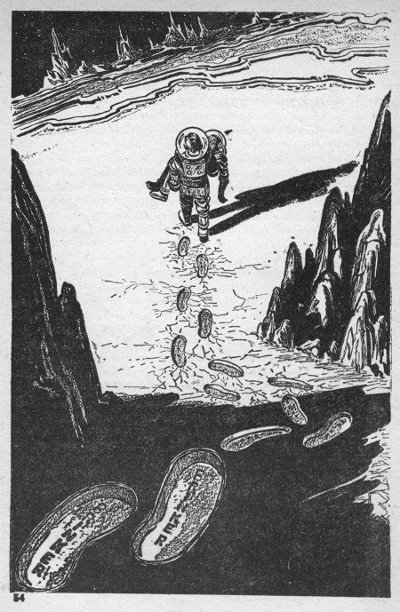
Retro Review of "Comet's Burial" (1953) by Raymond Z. Gallun

"Retro Review
of
'Comet's Burial'
(c) 1953
by
Raymond Z. Gallun"
(c) 2013
by
Jordan S. Bassior

Synopsis

Sometime in the future (given the backstory, it's probably around the mid-21st century), the Moon has been opened to mining.  However, the future of human settlement on Luna is limited by the lack of readily-available water.  There is believed to be plenty of water and other volatiles deep under the surface, but they are too deep for humans to access:  two hundred miles down.

Arne Copeland, age 19, has come to the Moon to make his fortune as a prospector and then come back to Iowa to marry his girl Frances.  Arne meets Jess Brinker, a "big, swaggering" man in his thirties.  Jess was the son of Tom Brinker, a promoter who dreamed of large-scale Lunar settlement but failed owing to the lack of resources.  Tom was recently murdered -- Jess believes by Tom's own ex-partner,

Because of his parentage and own eccentric nature, Jess Brinker has a bad reputation.  Nevertheless, Arne is drawn to the older man and decides to become his partner.


Sunday, February 10, 2013

"The Moonlit Road" (1907) by Ambrose Bierce

"The Moonlit Road"
(c) 1907
by
Ambrose Bierce

1. Statement of Joel Hetman, Jr.

I am the most unfortunate of men. Rich, respected, fairly well educated and of sound health -- with many other advantages usually valued by those having them and coveted by those who have them not -- I sometimes think that I should be less unhappy if they had been denied me, for then the contrast between my outer and my inner life would not be continually demanding a painful attention. In the stress of privation and the need of effort I might sometimes forget the sombre secret ever baffling the conjecture that it compels.

I am the only child of Joel and Julia Hetman. The one was a well-to-do country gentleman, the other a beautiful and accomplished woman to whom he was passionately attached with what I now know to have been a jealous and exacting devotion. The family home was a few miles from Nashville, Tennessee, a large, irregularly built dwelling of no particular order of architecture, a little way off the road, in a park of trees and shrubbery.

At the time of which I write I was nineteen years old, a student at Yale. One day I received a telegram from my father of such urgency that in compliance with its unexplained demand I left at once for home. At the railway station in Nashville a distant relative awaited me to apprise me of the reason for my recall: my mother had been barbarously murdered -- why and by whom none could conjecture, but the circumstances were these.
    
My father had gone to Nashville, intending to return the next afternoon. Something prevented his accomplishing the business in hand, so he returned on the same night, arriving just before the dawn. In his testimony before the coroner he explained that having no latchkey and not caring to disturb the sleeping servants, he had, with no clearly defined intention, gone round to the rear of the house. As he turned an angle of the building, he heard a sound as of a door gently closed, and saw in the darkness, indistinctly, the figure of a man, which instantly disappeared among the trees of the lawn. A hasty pursuit and brief search of the grounds in the belief that the trespasser was some one secretly visiting a servant proving fruitless, he entered at the unlocked door and mounted the stairs to my mother's chamber. Its door was open, and stepping into black darkness he fell headlong over some heavy object on the floor. I may spare myself the details; it was my poor mother, dead of strangulation by human hands!
    
Nothing had been taken from the house, the servants had heard no sound, and excepting those terrible finger-marks upon the dead woman's throat -- dear God! that I might forget them! -- no trace of the assassin was ever found.
    
I gave up my studies and remained with my father, who, naturally, was greatly changed. Always of a sedate, taciturn disposition, he now fell into so deep a dejection that nothing could hold his attention, yet anything -- a footfall, the sudden closing of a door -- aroused in him a fitful interest; one might have called it an apprehension. At any small surprise of the senses he would start visibly and sometimes turn pale, then relapse into a melancholy apathy deeper than before. I suppose he was what is called a 'nervous wreck.' As to me, I was younger then than now -- there is much in that. Youth is Gilead, in which is balm for every wound. Ah, that I might again dwell in that enchanted land! Unacquainted with grief, I knew not how to appraise my bereavement; I could not rightly estimate the strength of the stroke.
    
One night, a few months after the dreadful event, my father and I walked home from the city. The full moon was about three hours above the eastern horizon; the entire countryside had the solemn stillness of a summer night; our footfalls and the ceaseless song of the katydids were the only sound, aloof. Black shadows of bordering trees lay athwart the road, which, in the short reaches between, gleamed a ghostly white. As we approached the gate to our dwelling, whose front was in shadow, and in which no light shone, my father suddenly stopped and clutched my arm, saying, hardly above his breath:
    
'God! God! what is that?'
    
'I hear nothing,' I replied.
    
'But see -- see!' he said, pointing along the road, directly ahead.
    
I said: 'Nothing is there. Come, father, let us go in -- you are ill.'
He had released my arm and was standing rigid and motionless in the centre of the illuminated roadway, staring like one bereft of sense. His face in the moonlight showed a pallor and fixity inexpressibly distressing. I pulled gently at his sleeve, but he had forgotten my existence. Presently he began to retire backward, step by step, never for an instant removing his eyes from what he saw, or thought he saw. I turned half round to follow, but stood irresolute. I do not recall any feeling of fear, unless a sudden chill was its physical manifestation. It seemed as if an icy wind had touched my face and enfolded my body from head to foot; I could feel the stir of it in my hair.
    
At that moment my attention was drawn to a light that suddenly streamed from an upper window of the house: one of the servants, awakened by what mysterious premonition of evil who can say, and in obedience to an impulse that she was never able to name, had lit a lamp. When I turned to look for my father he was gone, and in all the years that have passed no whisper of his fate has come across the borderland of conjecture from the realm of the unknown.
   
2. Statement of Caspar Grattan

To-day I am said to live, to-morrow, here in this room, will lie a senseless shape of clay that all too long was I. If anyone lift the cloth from the face of that unpleasant thing it will be in gratification of a mere morbid curiosity. Some, doubtless, will go further and inquire, 'Who was he?' In this writing I supply the only answer that I am able to make -- Caspar Grattan. Surely, that should be enough. The name has served my small need for more than twenty years of a life of unknown length. True, I gave it to myself, but lacking another I had the right. In this world one must have a name; it prevents confusion, even when it does not establish identity. Some, though, are known by numbers, which also seem inadequate distinctions.
    
One day, for illustration, I was passing along a street of a city, far from here, when I met two men in uniform, one of whom, half pausing and looking curiously into my face, said to his companion, 'That man looks like 767.' Something in the number seemed familiar and horrible. Moved by an uncontrollable impulse, I sprang into a side street and ran until I fell exhausted in a country lane.
I have never forgotten that number, and always it comes to memory attended by gibbering obscenity, peals of joyless laughter, the clang of iron doors. So I say a name, even if self-bestowed, is better than a number. In the register of the potter's field I shall soon have both. What wealth!
    
Of him who shall find this paper I must beg a little consideration. It is not the history of my life; the knowledge to write that is denied me. This is only a record of broken and apparently unrelated memories, some of them as distinct and sequent as brilliant beads upon a thread, others remote and strange, having the character of crimson dreams with interspaces blank and black -- witch-fires glowing still and red in a great desolation.
    
Standing upon the shore of eternity, I turn for a last look landward over the course by which I came. There are twenty years of footprints fairly distinct, the impressions of bleeding feet. They lead through poverty and pain, devious and unsure, as of one staggering beneath a burden --
    
Remote, unfriended, melancholy, slow.
    
Ah, the poet's prophecy of Me -- how admirable, how dreadfully admirable!
    
Backward beyond the beginning of this via dolorosa -- this epic of suffering with episodes of sin -- I see nothing clearly; it comes out of a cloud. I know that it spans only twenty years, yet I am an old man.
    
One does not remember one's birth -- one has to be told. But with me it was different; life came to me full-handed and dowered me with all my faculties and powers. Of a previous existence I know no more than others, for all have stammering intimations that may be memories and may be dreams. I know only that my first consciousness was of maturity in body and mind -- a consciousness accepted without surprise or conjecture. I merely found myself walking in a forest, half-clad, footsore, unutterably weary and hungry. Seeing a farmhouse, I approached and asked for food, which was given me by one who inquired my name. I did not know, yet knew that all had names. Greatly embarrassed, I retreated, and night coming on, lay down in the forest and slept.
The next day I entered a large town which I shall not name. Nor shall I recount further incidents of the life that is now to end -- a life of wandering, always and everywhere haunted by an overmastering sense of crime in punishment of wrong and of terror in punishment of crime. Let me see if I can reduce it to narrative.
    
I seem once to have lived near a great city, a prosperous planter, married to a woman whom I loved and distrusted. We had, it sometimes seems, one child, a youth of brilliant parts and promise. He is at all times a vague figure, never clearly drawn, frequently altogether out of the picture.
    
One luckless evening it occurred to me to test my wife's fidelity in a vulgar, commonplace way familiar to everyone who has acquaintance with the literature of fact and fiction. I went to the city, telling my wife that I should be absent until the following afternoon. But I returned before daybreak and went to the rear of the house, purposing to enter by a door with which I had secretly so tampered that it would seem to lock, yet not actually fasten. As I approached it, I heard it gently open and close, and saw a man steal away into the darkness. With murder in my heart, I sprang after him, but he had vanished without even the bad luck of identification. Sometimes now I cannot even persuade myself that it was a human being.
    
Crazed with jealousy and rage, blind and bestial with all the elemental passions of insulted manhood, I entered the house and sprang up the stairs to the door of my wife's chamber. It was closed, but having tampered with its lock also, I easily entered, and despite the black darkness soon stood by the side of her bed. My groping hands told me that although disarranged it was unoccupied.
    
'She is below,' I thought, 'and terrified by my entrance has evaded me in the darkness of the hall.' With the purpose of seeking her I turned to leave the room, but took a wrong direction -- the right one! My foot struck her, cowering in a corner of the room. Instantly my hands were at her throat, stifling a shriek, my knees were upon her struggling body; and there in the darkness, without a word of accusation or reproach, I strangled her till she died! There ends the dream. I have related it in the past tense, but the present would be the fitter form, for again and again the sombre tragedy re-enacts itself in my consciousness -- over and over I lay the plan, I suffer the confirmation, I redress the wrong. Then all is blank; and afterward the rains beat against the grimy windowpanes, or the snows fall upon my scant attire, the wheels rattle in the squalid streets where my life lies in poverty and mean employment. If there is ever sunshine I do not recall it; if there are birds they do not sing.
There is another dream, another vision of the night. I stand among the shadows in a moonlit road. I am aware of another presence, but whose I cannot rightly determine. In the shadow of a great dwelling I catch the gleam of white garments; then the figure of a woman confronts me in the road -- my murdered wife! There is death in the face; there are marks upon the throat. The eyes are fixed on mine with an infinite gravity which is not reproach, nor hate, nor menace, nor anything less terrible than recognition. Before this awful apparition I retreat in terror -- a terror that is upon me as I write. I can no longer rightly shape the words. See! they --
    
Now I am calm, but truly there is no more to tell: the incident ends where it began -- in darkness and in doubt.
    
Yes, I am again in control of myself: 'the captain of my soul.' But that is not respite; it is another stage and phase of expiation. My penance, constant in degree, is mutable in kind: one of its variants is tranquillity. After all, it is only a life-sentence. 'To Hell for life' -- that is a foolish penalty: the culprit chooses the duration of his punishment. To-day my term expires.
    
To each and all, the peace that was not mine.
   
3. Statement of the Late Julia Hetman, through the Medium Bayrolles

I had retired early and fallen almost immediately into a peaceful sleep, from which I awoke with that indefinable sense of peril which is, I think, a common experience in that other, earlier life. Of its unmeaning character, too, I was entirely persuaded, yet that did not banish it.

My husband, Joel Hetman, was away from home; the servants slept in another part of the house. But these were familiar conditions; they had never before distressed me. Nevertheless, the strange terror grew so insupportable that conquering my reluctance to move I sat up and lit the lamp at my bedside. Contrary to my expectation this gave me no relief; the light seemed rather an added danger, for I reflected that it would shine out under the door, disclosing my presence to whatever evil thing might lurk outside. You that are still in the flesh, subject to horrors of the imagination, think what a monstrous fear that must be which seeks in darkness security from malevolent existences of the night. That is to spring to close quarters with an unseen enemy -- the strategy of despair!
Extinguishing the lamp I pulled the bedclothing about my head and lay trembling and silent, unable to shriek, forgetful to pray. In this pitiable state I must have lain for what you call hours -- with us there are no hours, there is no time.
    
At last it came -- a soft, irregular sound of footfalls on the stairs! They were slow, hesitant, uncertain, as of something that did not see its way; to my disordered reason all the more terrifying for that, as the approach of some blind and mindless malevolence to which is no appeal. I even thought that I must have left the hall lamp burning and the groping of this creature proved it a monster of the night. This was foolish and inconsistent with my previous dread of the light, but what would you have? Fear has no brains; it is an idiot. The dismal witness that it bears and the cowardly counsel that it whispers are unrelated. We know this well, we who have passed into the Realm of Terror, who skulk in eternal dusk among the scenes of our former lives, invisible even to ourselves, and one another, yet hiding forlorn in lonely places; yearning for speech with our loved ones, yet dumb, and as fearful of them as they of us. Sometimes the disability is removed, the law suspended: by the deathless power of love or hate we break the spell -- we are seen by those whom we would warn, console, or punish. What form we seem to them to bear we know not; we know only that we terrify even those whom we most wish to comfort, and from whom we most crave tenderness and sympathy.
    
Forgive, I pray you, this inconsequent digression by what was once a woman. You who consult us in this imperfect way -- you do not understand. You ask foolish questions about things unknown and things forbidden. Much that we know and could impart in our speech is meaningless in yours. We must communicate with you through a stammering intelligence in that small fraction of our language that you yourselves can speak. You think that we are of another world. No, we have knowledge of no world but yours, though for us it holds no sunlight, no warmth, no music, no laughter, no song of birds, nor any companionship. O God! what a thing it is to be a ghost, cowering and shivering in an altered world, a prey to apprehension and despair!
No, I did not die of fright: the Thing turned and went away. I heard it go down the stairs, hurriedly, I thought, as if itself in sudden fear. Then I rose to call for help. Hardly had my shaking hand found the door-knob when -- merciful heaven! -- I heard it returning. Its footfalls as it remounted the stairs were rapid, heavy and loud; they shook the house. I fled to an angle of the wall and crouched upon the floor. I tried to pray. I tried to call the name of my dear husband. Then I heard the door thrown open. There was an interval of unconsciousness, and when I revived I felt a strangling clutch upon my throat -- felt my arms feebly beating against something that bore me backward -- felt my tongue thrusting itself from between my teeth! And then I passed into this life.
    
No, I have no knowledge of what it was. The sum of what we knew at death is the measure of what we know afterward of all that went before. Of this existence we know many things, but no new light falls upon any page of that; in memory is written all of it that we can read. Here are no heights of truth overlooking the confused landscape of that dubitable domain. We still dwell in the Valley of the Shadow, lurk in its desolate places, peering from brambles and thickets at its mad, malign inhabitants. How should we have new knowledge of that fading past?
    
What I am about to relate happened on a night. We know when it is night, for then you retire to your houses and we can venture from our places of concealment to move unafraid about our old homes, to look in at the windows, even to enter and gaze upon your faces as you sleep. I had lingered long near the dwelling where I had been so cruelly changed to what I am, as we do while any that we love or hate remain. Vainly I had sought some method of manifestation, some way to make my continued existence and my great love and poignant pity understood by my husband and son. Always if they slept they would wake, or if in my desperation I dared approach them when they were awake, would turn toward me the terrible eyes of the living, frightening me by the glances that I sought from the purpose that I held.
On this night I had searched for them without success, fearing to find them; they were nowhere in the house, nor about the moonlit dawn. For, although the sun is lost to us for ever, the moon, full-orbed or slender, remains to us. Sometimes it shines by night, sometimes by day, but always it rises and sets, as in that other life.
    
I left the lawn and moved in the white light and silence along the road, aimless and sorrowing. Suddenly I heard the voice of my poor husband in exclamations of astonishment, with that of my son in reassurance and dissuasion; and there by the shadow of a group of trees they stood -- near, so near! Their faces were toward me, the eyes of the elder man fixed upon mine. He saw me -- at last, at last, he saw me! In the consciousness of that, my terror fled as a cruel dream. The death-spell was broken: Love had conquered Law! Mad with exultation I shouted -- I must have shouted,' He sees, he sees: he will understand!' Then, controlling myself, I moved forward, smiling and consciously beautiful, to offer myself to his arms, to comfort him with endearments, and, with my son's hand in mine, to speak words that should restore the broken bonds between the living and the dead.
    
Alas! alas! his face went white with fear, his eyes were as those of a hunted animal. He backed away from me, as I advanced, and at last turned and fled into the wood -- whither, it is not given to me to know.
    
To my poor boy, left doubly desolate, I have never been able to impart a sense of my presence. Soon he, too, must pass to this Life Invisible and be lost to me for ever.

END. 

"Comet's Burial" (1953) by Raymond Z. Gallun

Illustration_BRINKER_BRINKER_in_footprints
A man may be a scoundrel, a crook, a high-phased confidence man, and still work toward a great dream which will be worth far more than the momentary damage his swindles cost.


"Comet's Burial"

(c) 1953

by Raymond Z. Gallun

OUTSIDE Tycho Station on the Moon, Jess Brinker showed Arne Copeland the odd footprints made in the dust by explorers from Mars, fifty million years ago. A man-made cover of clear plastic now kept them from being trampled.

"Who hasn't heard about such prints?" Copeland growled laconically. "There's no air or weather here to rub them out—even in eternity. Thanks for showing a fresh-arrived greenhorn around..."

Copeland was nineteen, tough, willing to learn, but wary. His wide mouth was usually sullen, his grey eyes a little narrowed in a face that didn't have to be so grim. Back in Iowa he had a girl. Frances. But love had to wait, for he needed the Moon the way Peary had once needed the North Pole.

Earth needed it, too—for minerals; as an easier, jump-off point to the planets because of its weak gravity; as a place for astronomical observatories, unhampered by the murk of an atmosphere; as sites for labs experimenting in forces too dangerous to be conducted on a heavily-populated world, and for a dozen other purposes.

Young Copeland was ready for blood, sweat, and tears in his impulse to help conquer the lunar wastes. He sized up big, swaggering Jess Brinker, and admitted to himself that this man, who was at least ten years his senior, could easily be a phony, stalking suckers. Yet, Copeland reserved judgment. Like any tenderfoot anywhere, he needed an experienced man to show him the ropes.

He already knew the Moon intimately from books: A hell of silence, some of it beautiful: Huge ringwalls. Blazing sunlight, inky shadow. Grey plains, black sky. Blazing stars, with the great blurry bluish globe of Earth among them. You could yearn to be on the Moon, but you could go bats and die there, too—or turn sour, because the place was too rough for your guts.

Afield, you wore a spacesuit, and conversed by helmet radiophone. Otherwise you lived in rooms and holes dug underground, and sealed up. The scant water you dared use was roasted out of gypsum rock. The oxygen you breathed was extracted from lunar oxides by a chemical process. Then air-rejuvenator apparatus reseparated it from the carbon-dioxide you exhaled, so that you could use it over and over.

Copeland had read the tales: With that kind of frugality as the price of survival, lunar prospectors could turn selfish to the point of queerness. Afraid somebody might follow them to their mineral claims, they'd take more pains to leave as little spoor as possible than a fox being tracked by dogs.

"Speaking of how footprints last around here," Copeland remarked for the sake of conversation, "I understand you've got to be careful—stick to high ridges, and to parts of the flat maria where there's no old volcanic ash or dust of thermal erosion."

"Guys who do that are misers and old women, kid," Brinker scoffed. "Hell—it sure ain't because they're modest that they're so cautious! Me—I do things right."

He lifted a foot from the dust beside the path, revealing the mark of the specially etched steel sole of his spaceboot. A name was stamped across the print: BRINKER.

"I'm proud of where I've been and where I'm going—like a true explorer," the big man said. "Get some soles like mine made for yourself, fella, and come along with me."

Copeland was intrigued. "Let me think about it a little."


DURING the next few hours he heard quite a lot.

A big, blonde nurse—one of the two women in the sealed warrens of Tycho Station, said: "Young man, I love Jess Brinker. But keep away from him, or you'll wind up in the prison pits, or worse."

And Copeland heard about Tom Brinker, Jess' dad—the kind of swindler always found in rough new territory, anywhere. He had promoted the idea of a real city on Lunar. Yeah—one with trees and flowers. What sentimental bait that was for home-starved, desolation-sick wanderers! No wonder somebody had murdered him recently.

By common opinion, twenty-odd years was the only difference between Jess and his father. "Stay clear," was the warning; the name of Brinker was mud and poison.

Arne Copeland was a cagey youngster; nobody influenced him when he made up his mind. He was no cow-eyed hero-worshipper; yet, on his own, he kind of liked the large, battered, egotist. Copeland knew that he was an egotist himself. He also knew that merely to be on the sketchily-explored Moon was to take chances.

So he said "Okay," to Brinker, and got some metal boot-soles made, with his name etched into them in reverse, as in a rubber stamp.

Under packs that no coolie could ever have lifted against Earth gravity, they left Tycho Station and moved toward the fringe of that lunar hemisphere which is never seen from Terra—though it is no different from the visible half in general character.

Wherever their feet found a medium that would take an impression, they left their trademark behind them. Copeland could brush a name out with a glove; otherwise those names were about as permanent as if carved from granite, for there was no wind to blow the dust, and no rain to wash it away. Passing tractor-caravans would never blot out all of the footprints. Not in ages of time.

"At least we got us a monument, Jess," Copeland said once, feeling somewhat thrilled. "That's what guys out exploring and prospecting need. A legend. A reputation."

Jess Brinker's eyes narrowed, making him look sinister. "Yeah, Cope," he drawled. "But in my case it's a counter-reputation, with a little of Robin Hood thrown in, to help blow the stink of my Old Man off me. I want some friends and backing, so I can do what Dad really wanted to do—though he was as much of a rogue as a saint. You listening, Cope?"

Copeland kept his face stony. "Tell me what you want to, and then stop," he said softly.

"Thanks," Brinker answered. "It doesn't matter too much that I can guess who killed Pop, and would like to square things. Yeah, a hatchet-faced ex-partner who turned pious and legal on the outside, after he got the breaks. How old is that story, I wonder? ... It doesn't even rile me terribly, knowing that Dad wasn't all crook, knowing he believed his idea was good for everybody, and was trying to get funds to put it across."

Brinker sighed and went on: "The idea is the important thing, Cope. A place with trees and flowers, a city, maybe—an antidote for the Moon's desolation. Anyone here feels the need in his bones and nerves. But it would take more air and water than could ever be imported, or drawn from the lunar crust. You wouldn't know it on the dead surface, but two hundred miles deep in the Moon there's still molten lava, plentiful water in the form of steam, volcanic carbon-dioxide gas—the makings of oxygen. There's nitrogen, too.

"How to reach that stuff is the question. Drills break under the pressure of depth at a tenth of the distance. Pop's idea involved Brulow's Comet, which will be coming back sunward from far space in three years. Imagine—a comet! It could be dangerous, too; nobody could ever get permission for an attempt."

Brinker paused again. Copeland and he were plodding through a jagged valley. The stars were merciless pinpoints, the silence brittle and grating.

"But there must be a way of blasting down to those life-giving raw-materials, Cope," Brinker continued. "Maybe with atomic explosive. Experiments call for funds and backing. So I save my money, and wish I had a head for making it faster. And I look for weak spots in the lunar crust with radar. And I try to get people to know I'm around, and to like me..."

Copeland realized that what he had just heard could be a line of malarky meant to kid a yokel, or a bid to get him involved in something. But he found himself kind of falling for the yarn. More than ever he suspected that folks were wrong about Jess Brinker; his warning instincts were being lulled to sleep.


MONTH-LONG lunar days passed, while the two men ranged over a segment of the hidden hemisphere. They trod plains and crater-walls unsullied by human feet before; they took photographs to be sold to the Lunar Topographical Commission; they located deposits of radioactive metals, which could be registered for investigation by an assaying party, and for possible royalties. Periodically they visited scattered supply stations, and then set out once more.

Such a life had its poisons even for Brinker and Copeland, who were braced for meeting the unknown and the strange.

Living in space suits for weeks at a time; smelling their own unwashed bodies; slipping an arm out of a heavy sleeve to draw food through a little airlock in their armor's chestplate; knowing, in spite of effective insulation, that the heat of day exceeded the boiling point of water, and that the cold of the protracted night, when usually they continued their explorations with the aid of ato-lamps, hovered at the brink of absolute zero—all those things had a harsh effect on nervous-systems.

They found two human corpses. One had been crushed in a long fall, his spacesuit ripped open; he was a blackened mummy. The other was a freckled youth, coffined in his armor. Failure of its air-rejuvenator unit had caused asphyxia. What you did for guys like this was collect their credentials for shipment home.

Copeland also found a Martian—inside its transparent version of a spacesuit, for the ancient Moon had been much the same as now. The being was dead, of course. Its brain-case had been a sac; its tentacles were like a snarl of age-hardened leather thongs.

Lying near it was an even greater rarity—the remains of a different sort of monster from the planet that had been literally exploded in a war with Mars, to form the countless fragments that were the asteroids. That much of remote history was already known from the research-expeditions that had gone out to the Red Planet, and beyond.

The queer, advanced equipment of these two beings from two small, swift-cooling worlds—which had borne life early, and whose cultures had rivalled briefly for dominance of the solar system until they had wiped each other out those fifty million years ago—lay scattered near them. It was still as bright and new as yesterday, preserved by the Moon's vacuum: Cameras, weapons, instruments—rich loot, now, to be sold to labs that sought to add the technology of other minds to human knowledge.

For a year, things went well. The names, BRINKER and COPELAND, footprinted into the lunar dust, helped build the new reputation that Brinker wanted. Copeland and he were a hard-working team; they covered more ground than any other Moon explorers.

The fights that Brinker got into with other toughs at the various supply stations, and never lost, added to the legend—that old Tom's son was savage and dangerous, but with a gentler side. For instance he once carried a crazed Moon-tramp, whom Copeland was too slight to have handled for a minute, fifty miles on his back to a station. Oh, sure—the stunt could be pure ballyhoo, not charity. But Copeland knew that more and more people had begun to admire his buddy.

Brinker never found a weak spot in the lunar crust. "It's always about two hundred miles deep, Cope," he said. "Lots thicker than Earth's shell, because the Moon, being smaller, cooled more. But don't worry; nothing is impossible. Soon I'll have enough money to make minor tests. And maybe enough friends for serious support."

Yeah—maybe it was all just a brain-bubble. But Copeland had seen enough of desolation to grind the spirit of the Brinker idea into his bones—even if he didn't think it was quite practical.

"I'll throw my dough in with yours, Jess," he said.

Their named bootprints helped build their fame as explorers; but there was a flaw and an invitation here which they both must have realized—and still faced as a calculated risk.


A LUNAR day later, they were plodding through the Fenwick mountains on the far hemisphere, when streams of bullets made lava chips fly.

As they flopped prone in the dust, a scratchy voice chuckled: "Hello, Brinker. Maybe you and your pal want my bunch to escort you back to Tycho Station. We might as well have the reward. Robbery of a minerals caravan and three killings, they say. It's terrible how you scatter your tracks around..."

Brinker grasped Copeland's wrist to form a sound-channel, so that they could converse without using their radiophones. "That was Krell talking," he said. "Dad's old partner."

Luckily, it was not many hours to sunset. The mountain ridges, slanting up to the peaks, cast inky shadows that could hide anything. Brinker was canny; while more bullets spurted, he led a dash back to a ridge-shadow that went clear to the range-crest. Even with bulky packs, climbing was a lot faster than on Earth, where things weigh six times as much.

So they got away, over the mountains. The black night of the far side of the Moon, where Earth never shines, hid them.

"Making boot-soles with our names on them," Brinker growled bitterly, using the radiophone at reduced range. "The crudest kind of frameup."

"Your Krell is quite a man," Copeland stated.

"He could have arranged all of it—sure," Brinker answered. "He knows I suspect that he finished Pop, so I'm dangerous to him. He might hate me, too, as part of my Old Man—sort of ... Whatever it was he got sore about, originally—money or principle, no doubt ... Besides, I don't think he wants the Moon to be a little more livable. It would encourage too many colonists to come, increase metals production, spoil prices, cheapen his claims. He's a corny man, with all the corny reasons ...

"He, and some of his guys, could have robbed and killed and left footprints like ours. But any other lugs, seeking someone else to blame for their crimes, could have done all that. If that is so, Krell has got me even legally—without blame to himself."

"Footprints!" Copeland snapped. "They're so obviously a frame that it's silly; anyone could see that! Another thing—maybe Krell was kidding, scaring us by saying that we are wanted. Tell you what, Jess: In any case I won't seem as guilty as you; I'll go back alone to Tycho Station, and clear us both."

"You're an optimist, ain't you?" Brinker laughed. "Krell wasn't kidding; and in a rough place like the Moon, justice jumps to conclusions and gets mean, fast. Sure, the purpose of the footprints is obvious. But I've been fighting uphill against my Old Man's reputation for a long time. Who's gonna say I haven't backslid? What I want to accomplish is tough enough with everything in my favor."

Brinker's voice was now a sinister rumble with a quiver in it. Arne Copeland turned wary again; he had never lost entirely the deepseated notion that Brinker might cause him misfortune.

"So now what?" he demanded softly, flashing his ato-light beam against Brinker's face-window, so that he could see his expression. Copeland meant to forestall danger aggressively.

But as the darkness between them was swept aside, he also saw the muzzle of Brinker's pistol levelled at him. The bigger man's grin was lopsided. "I'd give you my neck, Cope," he rumbled. "But I'd give both our necks for you-know-what. Now, because that's all there's left, I'm gonna try it Pop's crazy way. You're gonna help. If you and I can last through a couple of years of real silence and solitude, it might have a chance. I got a ship hidden. Give me your gun. Easy! If you think I wouldn't shoot, you're a fool. Now I'll wire one of your wrists to mine; we've got a long march ahead."


SOME march it was! Copeland was fiercely independent. The warnings about Brinker had gone to waste; so had his own wariness. Bitterness made him savage. The harshness of the Moon still ached in his guts—he wanted the steam and gases of its interior tapped and used, yes—but by some reasonable means. Jess Brinker must be truly Moon-balmy, now. Desolation-nuts. Wild for the sight of growing things. Else how could he think seriously of using Brulow's Comet? Was it hard to guess how? Copeland knew that he and Brinker had courage, and willingness to work for a sound purpose. But to trade long effort and hardship in a proposition that courted suicide, even in its probable failure—and wide destruction if it managed to be successful—was worse than folly.

So, when these meanings became clear in his mind, he wrestled Brinker at every turn. Twice he almost won. He argued and cursed, getting nowhere. He defied Brinker to shoot him. The big man didn't do that. But at last Brinker jabbed a hypodermic needle—part of the regulation medical kit—through the flexible rubberized fabric of the elbow-joint of Copeland's spacesuit, and into his arm.

Many hours later, and many miles farther into the mountainous country, Copeland awoke in a cavern with glassy walls, illuminated by Brinker's ato-light. Brinker stood near where he lay. He seemed just grimly good-humored.

"This is an old Martian supply depot, Cope," he offered. "I found it before I knew you, and I kept it in reserve for possible trouble, like now. I knew I could convert its contents to considerable money at any time. So it was like a bank-account, and a last resort, too. There's even a small Martian spaceship; only three others have ever been found, intact. I also cached some Earthly instruments here. You can bet I didn't leave any tracks for miles around."

Copeland's gaze caught the errie gleam of the strange little craft. He saw the stacks of oddly-made boxes and bales. His hackles rose as he thought of a senseless plunge into unplumbed distance.

"Unwire my hands, Jess!" he coaxed again, trying to control fury. "Get wise! Damn you—you're more dangerous as an altruist than any crook could be!"

Brinker's laugh was sharp, but his eyes held real apology. "Want to help me ready and load the ship?" he said almost mildly. "No—I guess not; you aren't quite in a cooperative frame of mind, yet. I'll need you later. Sorry, but you're the only guy around, Cope."
Brinker blasted queer bulkheads out of the ship, in order to make it habitable for humans. The exit of the cavern had been masked with debris, but now he cleared it. He tossed Copeland aboard and took off into the lunar night.


THE vast journey lasted for months. Once Brinker said to his sullen, and again partially-drugged, captive: "Maybe in two years, if we're very lucky, we'll be back."

Hurtling outward, they passed the orbits of Mars, the asteroids, Jupiter, and Saturn. There, with Earth-made instruments, Brinker located what he sought: Brulow's Comet.

So far from the sun, where the fluorescence-inducing radiations were thinned almost to nothing, it glowed hardly at all. And it had almost no tail; it was only a gigantic, tenuous ghost, with a core of stone and magnetic iron fragments.

Still dazed, Copeland thought about comets. Wanderers, following elongated orbits that loop tight around the sun at one end and plumb the depths of space at the other. Of all large forms moving through the void, they were the least dense. In coma and tail, they were only intensely rarefied and electrified gas. The great enigma about them was that things so deficient in mass and gravity could hold onto even that much atmosphere for long. Perhaps new gases were baked out of the meteoric core, each time a comet was close to the sun; maybe some of them even renewed their atmosphere periodically, by capturing a little of the tenuous substance of the solar corona, during their very near approaches to it.

Brulow's Comet was on the sunward swing, now, gaining speed under solar gravitation; but it still had a long ways to go. Brinker guided the ship down through its coma and toward its lazily-rotating nucleus, where thousands of fragments of iron and rock swirled around their common center of gravity.

The chunks clattered against the craft's metal hull, but did no damage at their low speed. Brinker brought the ship to rest at the center of the nucleus, where there was one solid mass of material a hundred yards in diameter.

"Well, we're here, Cope," Brinker said grimly. "We don't have to work right away—if you don't want to. We've got too much time."

Those two years looming ahead were the worst. If the Moon had been harsh, it was nothing to this eerie place. The heart of this small comet was illumined by faint, shifting phosphorescence, ranging from blue and tarnished silver to delicate if poisonous pink. Perhaps the cause was the same as that of the terrestrial aurora. The silence here was that of space; but the swirling motion of the nucleus suggested a continuous maddening rustle to Copeland.

He had to yield to Brinker's wishes. Toil might divert him some, keep him from feeling the tension of time and strangeness so much.

"Okay, Brinker," he said. "You win. Brulow's Comet is headed for a close approach to the Earth-Moon system. So you want to be spectacular, and shift it a little from its orbit—so that it will hit the Moon and maybe break its crust. Was that so hard to figure? That sounds pretty big, doesn't it? But I'll humor you. Let's see how far we get ... Since we're here." His sarcasm was tired.

As a preliminary, they cut a cavern in the central mass of the nucleus with Martian blasters, and fitted it with a crude airlock. The cavern would be better to live in than the interior of a ship meant for alien beings. They moved Martian apparatus and supplies into it: Air-rejuvenators, moisture-reclaimers, cylinders of oxygen and water, and containers of nourishment—all millions of years old.

Their remaining supply of Earthly food in their packs was now very short. It was weird—eating what had been preserved so long ago, on another world, for beings just barely close enough to human for their food to be edible. Gelatins, sectional fragments of vegetation, and what might have been muscle-tissue. Copeland and Brinker both gagged often. It wasn't the bland, oily taste so much, but the idea....

Some of it, Copeland decided, was not native Martian. It was more like terrestrial fish. And slabs of coarse meat might have been flesh of the last dinosaurs! Martians surely must have visited Earth briefly, though evidence there had long since weathered away.


WHILE the still-distant sun sent thin light into the comet, Brinker and Copeland removed the propulsion-tubes from the ship and welded them to the central chunk of the nucleus. They had a number of other spare jet-tubes. These they fastened to lesser masses.

Whenever, in the slow swirling of the nucleus, tubes pointed in the calculated proper direction at right angles to the comet's course, they were fired in long bursts. Thus, slowly, like a perfectly-balanced bank vault door moved by a finger, the mass of the comet—slight by volume, but still measuring many thousands of tons—was deflected in the opposite direction. Astrogation-instruments showed the shift. Copeland had expected such coarse deflection to be possible; still, it startled him—this was the moving of a celestial body!

"Just a little—for now, Cope," Brinker said. "We'll leave the fine aiming for later. Meanwhile we've got to pass the time, stay as well as we can, and keep our heads on straight."

Sure—straight! If Brinker hadn't turned foolish before they had come, they wouldn't be out here at all. In a month they were already thinning down from malnutrition and strain. At first, thinking coldly, Copeland was sure they'd wilt and die long before they got near the Moon.

Then, as they managed to steady themselves some by the diversions of playing cards, and studying the intricacies of Martian equipment, he began to fear once more that Brinker might succeed in his efforts—but fail terribly in result.

Many times Copeland went over the same arguments, struggling to speak calmly, and without anger: "I wonder if you realize it, Brinker—with enough velocity one large meteor carries more energy than a fission bomb. A whole comet would affect thousands of square miles of the lunar surface, at least. Smash equipment, kill men. And if the comet happened to miss the Moon and hit Earth—"

Sometimes Brinker's expression became almost fearful, as at an enormity. But then he'd turn stubborn and grin. "There's plenty of room to avoid hitting the Earth," he'd say. "On the Moon, astronomers will warn of the shifted orbit of Brulow's Comet in plenty of time for everybody to get out of danger. Most of what we've got to worry about now, is our lives, or jail ..."

A moment later, as like as not, they'd be slamming at each other with fists. Copeland found it hard to contain his fury for the man who had brought him such trouble, and—without intent—was so determined to extend it to many others.

Brinker kept winning the scraps. But Copeland's ten-year age-advantage meant something when it came to enduring hardship and partial-starvation over a long period. They didn't weaken equally.

This levelling of forces was one thing that Copeland waited for. Another was that when Brulow's Comet was found to be off course, a ship might be sent to investigate. He never mentioned it, certainly; but once Brinker said: "I'm ready for what you're thinking, Cope. I've got weapons."

By then they spent much of their time in torpid sleep.

Another difficulty was that it was getting harder to keep one's mind consistently on the same track. Space, tribulation, and the months, were having their blurring effect.

Often, Copeland spent many hours in wistful reverie about his girl, Frances, in Iowa. Sometimes he hated all people—on Earth, Moon, and everyhere, and didn't care what happened to them. On other occasions Brinker's basic desire to lessen the desolation of the lunar scene looked supremely good to him—as of course it always had, in principle. Then, briefly and perhaps madly, he was Brinker's pal, instead of yearning to beat him to a pulp.


SOMEHOW, twenty months crept by, and the first spaceship hove inquisitively close to Brulow's Comet. A shadow of his former self, Brinker crept out of the cavern to man his weapons. But like a famished beast seeking prey, Copeland followed him.

His victory, now, was almost easy. Then all he had to do was wait to be picked up; the ship was coming nearer. Through the now much-brightened glow of the comet, it had ceased to be a planetlike speck reflecting sunlight; and showed its actual form.
Confusion whirled in Copeland's head; hunger gnawed in him. Yet he looked down at Brinker—poor Brinker, beaten unconscious inside his spacesuit. Brinker had tried to fight lifeless dreariness. Copeland, weak of body and fogged of mind, was now close to maudlin tears. Dreariness was the enemy—here as elsewhere. He tried to think; his stubborn nature mixed itself with splinters of reason, and seemed to make sense.

His twenty months of suffering out here had to be used—mean something—didn't it? It couldn't be just a futile blank. You had to follow a thing started through to the end, didn't you? Brinker wanted to improve the Moon, which certainly needed that. Okay—finish the job that had gone so far. Damn desolation everywhere! Fight it! Smash it! Sudden rage made Copeland's thin blood pound. Dimly he realized that he was driven by the same dreariness-disease that motivated Brinker. So what? Who cared about smashed lunar equipment, after all. And beside experience, prison would be paradise.

Copeland fired a Martian rocket-launcher, aiming behind the ship. He saw the blaze of atomic fission. Jets flaming, the craft fled.
In his phones he heard a voice that he remembered: "That you, Brinker? Trying your father's trick, eh? Idiot! You'll kill yourself, or be executed. And now you even shoot!"

Fury at Krell clinched Copeland's decision. He did not answer him. But when Brinker woke up he said savagely, without friendship or forgiveness, yet with cooperation: "We're on the same side, now. Let's aim Brulow's Comet."

Concentrating was hard, but they had their instruments and calculators. Velocity, position, and course of both comet and Moon had to be coordinated to make them arrive in the same place at the same moment. It was a problem in astrogation, but a comet was not as easily directed as a space ship. Copeland had once thought that the necessary fine guiding couldn't be done. The jet-system they had rigged in that inconveniently whirling nucleus was crude.

But one thing was in their favor; they had ample time. They could adjust their course with the jets, check with instruments, and re-adjust—again and again. Copeland found himself doing the vital part of the job; he was better at math than Brinker.

They still had plenty of Martian food left—for what it was worth to human insides. Perhaps unified purpose and action brightened their outlook a little, helping their bodies. They could never work very long—even in the almost total absence of gravity. But—at least—their weakness wasn't increasing now.

During those last four months they drove several ships away. Earth and Moon swelled to spheres, ahead. Brulow's Comet lengthened its tail under increased solar light-pressure. Intensified radiation made its shifting colors glorious.

Brinker and Copeland lined their gigantic missile up on its target as perfectly as they could. Fifty hours before the crash was due, they smashed most of the jets. The remaining ones they tried, feebly, to refit into their ship, meaning thus to escape.


THREE Space Patrol craft showed up, and they had to man their weapons. Copeland hated to be an outlaw; but now he could not see effort brought to nothing. Brinker and he had survived so far, accomplishing much—far better results than he had expected; it made him surer that their purpose was generally sound.

More missiles were fired carefully—not to do damage, but to discourage the intruders; the latter were held at bay for another twelve hours. Copeland and Brinker left radio commands and threats unanswered, so it was hard for their opponents to get a fix on their position in the whirling nucleus.

Explosions blazed around them, but never very close. Masses of iron and stone were shattered and half vaporized, cooling subsequently to fine dust. The nucleus of Brulow's Comet expanded a bit under the battering that went on within it.

At an opportune moment, Copeland and Brinker clung to one of their jet-tubes and, gunning it very lightly, rode it from the central core-mass of the nucleus to a lesser meteor, and hid in a cleft. A dust-poll had concealed their change of position. And now, with so many other large meteors around them, they would be almost impossible to find.

They glimpsed the Patrol craft invading the heart of the comet. Men poured forth, struggling to set up jets in the hope of still deflecting this juggernaut from the Moon. But the comet was already much too close; before the setting-up was half completed it had to be abandoned. Still, the ships remained almost to the last.

Copeland wondered tensely if they'd ever go. His withered palms perspired.

"We could still yell for help—have them take us off," Brinker suggested when they had left. He spoke by sound-channel contact.

The Moon loomed huge and ugly ahead. Copeland gave it a scared glance, and then laughed grimly. "Ironic, that would be," he snapped, "No—we've got this jet to ride, and we're still at liberty."

From space, lashed to the flaming propulsion tube, they saw the crash happen. It was a terrific spectacle. Copeland's hopes now had jagged cracks of worry. The comet seemed to move slowly, its coma flattening over the Moon's spaceward hemisphere. There were blinding flashes as the chunks of its nucleus bit into the lunar crust, their energy of velocity converting largely to heat. Then dust masked the region of impact. The comet's tail collapsed over the Moon like a crumbling tower.

Copeland gulped. He saw that Brinker had gone limp—fainted. Weakness was enough to cause that; but the fact of a plan carried out had a shock in it, too.

Copeland worked the jury-rigged controls of the jet, continuing to decelerate. At spotty intervals, under the terrible thrust of reducing speed, he was unconscious, too.


THERE was no such thing as picking a landing-spot. Checking velocity soon enough, so close to the Moon, took all of the propulsion tube's power—so he just followed the comet down. Almost at a stand-still at last, balanced on a streamer of flame, he toppled into hot dust Feebly he worked to unlash himself from the tube. Brinker, jolted back to semi-consciousness, managed to do the same.

Weakened and spent, they could not even lift themselves against the slight lunar gravity for a while.

The darkness around them was Stygian. But as more dust settled, the sky cleared, and the normal stars of the lunar night blazed out. Their attention was drawn in one direction inevitably.

Red-hot lava glowed there, in scattered areas over what was clearly an extensive expanse of territory. White vaporous plumes spurted high above the ground, and against the sides of new-formed meteor-craters, a white layer was collecting.

Copeland staggered erect. "Frost and snow!" he stammered. "From volcanic steam! The first frost and snow on the Moon in a billion years! We've done it, Brinker! Brulow's Comet really did crack the thick lunar crust...."

He heard Brinker's grunt of premature enthusiasm.


The Patrol picked them up hours later, wandering dazedly. They were emaciated ghosts of men—almost skeletons in armor. They gave their names, but didn't really come to their senses until the prison doctor in Tycho Station treated them, and they had slept for a long time.

"Don't worry, fellas. Relax," he said—with fury in his eyes.

Other faces were grim.

At the speedy trial in Tycho Station, sharp-featured Krell was among many who flung accusations.

"In the impact-zone itself—an area a hundred miles across—mining installations and machinery of tremendous value were utterly destroyed," he said. "But lesser damage extends to a far wider circle. Thousands of claims have been buried in dust, till much of the far lunar hemisphere will have to be resurveyed. Luckily, miners and explorers were warned in time, and sought safety. But the charge of wholesale vandalism—terrible enough—does not stand alone. These men are to be remembered as accused robbers and murderers."

In rebuttal, Brinker's defiance was a little uncertain, as if under so much blame, he had lost his assurance.

"Men who know the Moon know that its barrenness is poison, and not right for people!" he growled. "I tried to change it with Brulow's Comet—when I had no success by other means. Anyway, Copeland is blameless. I forced him to help me."

Embitted, there was no warmth in Copeland for his older codefendant and jinx. Still, even without Brinker's attempt to shield him, he would have been loyal.

"During all important parts of mine and Jess Brinker's joint project," he told the court, "I was in full agreement with his purpose."

Their attorney accomplished one considerable victory before these angry people. The charge of previous murders and robbery was barred; it was admitted that footprints were easy to duplicate, and that the presence of some bearing the names of the guilty was unlikely.

Brinker got fifty years in the mine-pits, and Copeland thirty.

"You always figured I might get you in a jam, didn't you, Cope?" Brinker said. "I'll keep trying to fix that."


COPELAND found nothing to grin about, in a thirty-year sentence. It was goodbye wandering, goodbye girls, goodbye everything. He'd get out middle-aged, finished, and marked. He might as well stay another twenty with Brinker—complete a sour association with him.

Copeland had another recent jolt to brood over. A bunch of old letters from his Frances had been delivered to him. His inability to receive or answer any of them had brought the worst result. She had married another guy, and who could blame her?

Arne Copeland wanted to kill Brinker. Getting desolation-goofy, and dragging him into this mess.

But from Brinker's infuriating grin, Copeland caught a hot spark of hope, backed by reasoning.

Later, sweating in the penal mine-pits near Tycho Station, Brinker and Copeland still heard scraps of news.

Explorers moved back into the region where the comet had split the lunar crust. The rising columns of steam and gas were perhaps unspectacular phenomena in themselves. But there they were, ready to fill a tremendous need. The sleepy internal fires of the Moon were unlikely to be violent. Yet they would push vapors up to the surface here perhaps for centuries.

In balancing benefit against transient damage, was it necessary even to mention that deeper and richer mineral deposits had been laid bare for easy mining by the blast effect of the comet's downfall? All free men—good or bad, and of large or small holdings—were set to gain, Krell included. But better mines were a side-issue.

The prisoners soon heard how roofs of transparent, flexible plastic, brought in bundles like fabric, were being reared over that smashed-up region, to trap escaping volcanic vapors. One tentlike structure. Then another and another.

Here was ample water from volcanic steam, and vast quantities of carbon-dioxide from which ordinary air-rejuvenators could release breathable oxygen. Men who had lived so long in the lunar silence and barrenness, soon saw that these raw materials of life need not only be used locally, but could be piped anywhere.

"Folks have caught on, Cope," Brinker said. "They were a little desolation-balmy, too—hence on our side all the time. Now they'll feel better about my Old Man. There'll be more than one city, I'll bet—clusters of big, plastic air-bubbles, self-sealing against meteor-punctures, warmed inside at night by volcanic heat. It won't happen all at once, but it'll come. Seeds'll be planted, and houses built. Parts of the Moon won't look the same."

Krell's death was part of the turning tide. He was found in Tycho Station, head smashed by a boot-sole of metal; it was good that Brinker was in prison, because his name was printed into Krell's skull.

Who did it? Neither Brinker nor Copeland cared very much. Some wronged stooge of Krell's, no doubt. Let the forces of law figure out the details.

Things got really good for Copeland and Brinker after popular demand forced their vindication. They were feted, honored, praised, rewarded. All Earth knew of them, and feminine colonists arriving as part of a new phase of the Moon's development, shined up to them as heroes.

It is not to be said that they didn't enjoy the advantages of fame. Brinker said more than once: "Forget your Frances, Cope. Problems are easy, these days."

The time came when Copeland growled in answer: "Sure—too easy. Having a lot of pals after the need is gone. No—I'm not criticizing. Most folks are swell. But I'd like to make friends and maybe find love a little more naturally. I thought I'd stay on the Moon; now I think I'll shove off for Mars. People are going there; whole towns are being built, I understand. And there's plenty of room for a lunar tramp, with a prison-record, to get lost ..."

Copeland chuckled at the end. His vagabond blood was singing. He was also pitching a come-on at Brinker, for he'd seen him with some letters while they were prisoners. Copeland had glimpsed the name and address of the writer: Dorothy Wells, the big nurse that Brinker had known at Tycho Station. She was in Marsport now.

"By gosh—I guess I'll go too, Cope!" Brinker rumbled.

Looking back, Brinker thought it sort of funny that they were pals. He laughed.

END.